1μg (R: reducing condition, N: non-reducing condition).
MMP-9 His Tag Protein, Cynomolgus
MMP-9 His Tag Protein, Cynomolgus
Price:
Regular price
$300 USD
Regular price
Sale price
$300 USD
Unit price
per
For shipping services or bulk orders, you may request a quotation.
Secure checkout with

View full details
Product Details
Product Details
Product Specification
| Species | Cynomolgus |
| Synonyms | Type V Collagenase,Gelatinase B,EC 3.4.24.35,MANDP2,Matrix Metalloproteinase 9,CLG4B,MMP9,Matrix Metallopeptidase 9,Matrix Metalloproteinase 9 (Gelatinase B, 92kDa Gelatinase, 92kDa Type IV Collagenase),GELB,Matrix Metalloproteinase-9,92 KDa Type IV Collagenase,Macrophage Gelatinase,92 kDa gelatinase,MMP-9,Matrix Metallopeptidase 9 (Gelatinase B, 92kDa Gelatinase, 92kDa Type IV Collagenase),EC:3.4.24.35,EC 3.4.24 |
| Accession | XP_005569271.2 |
| Amino Acid Sequence | Ala20-Asp707 with His Tag at C-Terminus |
| Expression System | HEK293 |
| Molecular Weight | 80-95kDa (Reducing) |
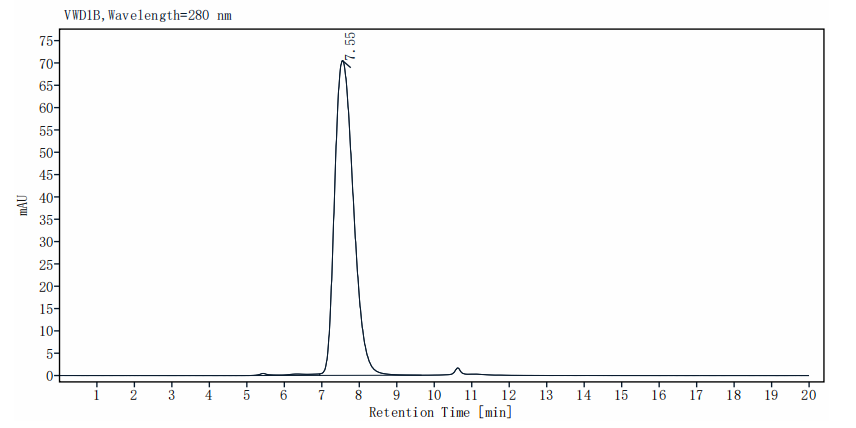
| Purity | > 95 % as determined by SDS-PAGE & SEC-HPLC |
| Endotoxin | <0.1EU/μg |
| Conjugation | Unconjugated |
| Tag | His Tag |
| Physical Appearance | Lyophilized Powder |
| Storage Buffer | PBS, PH7.4, 5% trehalose |
| Reconstitution | Reconstitute at 0.1-1 mg/ml according to the size in ultrapure water after rapid centrifugation. |
| Stability & Storage | · 12 months from date of receipt, lyophilized powder stored at -20 to -80℃. |
| Reference | 1.St-Pierre Y, et al. (2003) Emerging features in the regulation of MMP-9 gene expression for the development of novel molecular targets and therapeutic strategies. Curr Drug Targets Inflamm Allergy. 2(3): 206-15. |
Background
Matrix metalloproteinases (MMPs) are neutral proteases involved in extracellular matrix (ECM) breakdown and remodeling during physiological processes like morphogenesis, angiogenesis, and tissue repair, as well as in pathological conditions such as inflammation, arthritis, and cancer. MMP9, or 92-kDa gelatinase B/type IV collagenase, is secreted by neutrophils, macrophages, and transformed cells. It is critical for tissue remodeling in inflammatory processes and is a key product of macrophages and neutrophils. MMP9 is also released by lymphocytes and stromal cells in response to inflammatory cytokines or integrin-mediated signals. Excessive MMP9 production is linked to tissue damage and degenerative disorders, making its regulation a focus for therapeutic development. Its overexpression in cancer and inflammatory conditions highlights the importance of understanding the mechanisms controlling its expression to identify potential therapeutic targets.
Protocol
Experimental Method
Assay Principle: Detects the ability ofMMP-9protein to cleaveMca-PLGL-Dpa-AR-NH2.
Materials
Assay Buffer:50 mM Tris, 10 mM CaCl2, 150 mM NaCl, 0.05% (w/v) Brij 35, pH 7.5 (TCNB)
- MMP-9 His Tag Protein, Cynomolgus
p-aminophenylmercuric acetate (APMA) (Aladdin, Catalog # P649286)
Substrate:MCA-Pro-Leu-Gly-Leu-DPA-Ala-Arg-NH2 (R&D, ES001)
Standard:MCA-Pro-Leu-OH (Shyuanye, T77046)
96 ELISA Removable Plate, Black, High binding (GENEVER, Catalog # GMO2-96H)
Plate Reader (PerkinElmer, Excitation Wavelength/Emission Wavelength=320 nm/405 nm)
Procedure
In the assay buffer containing1mM APMA, dilute theMMP-9protein to100 μg/mL, and incubate at37°Cfor4hours to activate theMMP-9protein.
Dilute the activatedMMP-9protein with assay buffer to0.8, 0.4, 0.2 μg/mL.
Dilute the substrate in buffer to20 μM.
Add50 μLof the dilutedMMP-9protein (from Step 2) to the black plate, then add50 μL 20 μMsubstrate to initiate the reaction. Include wells containing only substrate and assay buffer as blank controls.
At320 nmexcitation wavelength and405 nmemission wavelength, read the fluorescence signal in kinetic mode (60seconds/cycle,20cycles).
Calculate Specific Activity:
Specific Activity (pmol/min/µg) = |
Adjusted Vmax (RFU/min) x Conversion Factor (pmol/RFU) |
amount of enzyme (µg) |
Standard Curve
Dilute the standard with assay buffer to10 μM, and perform serial dilutions.
Add100 μLof the serially diluted standards and blank (assay buffer) to the corresponding wells of the96-well plate. The concentration range for the standard curve is per well1000,500,250,125,62.5,31.25,15.625 pmol.
At excitation wavelength320 nmand emission wavelength405 nm, read the fluorescence signal in endpoint mode.
UsingMCA-Pro-Leu-OH pmolamount as the y-axis(y), and the relative fluorescence units after blank subtraction as the x-axis (x), perform linear regression analysis.
Picture
Picture
SDS-PAGE
SEC-HPLC
The purity of MMP-9 His Tag Protein, Cynomolgus is greater than 95% as determined by SEC-HPLC.
ELISA
Immobilized MMP-9 His Tag Protein, Cynomolgus (Cat. No. UA011191) at 2.0μg/mL (100μL/well) can bind MMP9 Recombinant Rabbit mAb (SDT-368-16) (Cat. No. S0B2297) with EC50 of 0.95-1.73ng/mL.