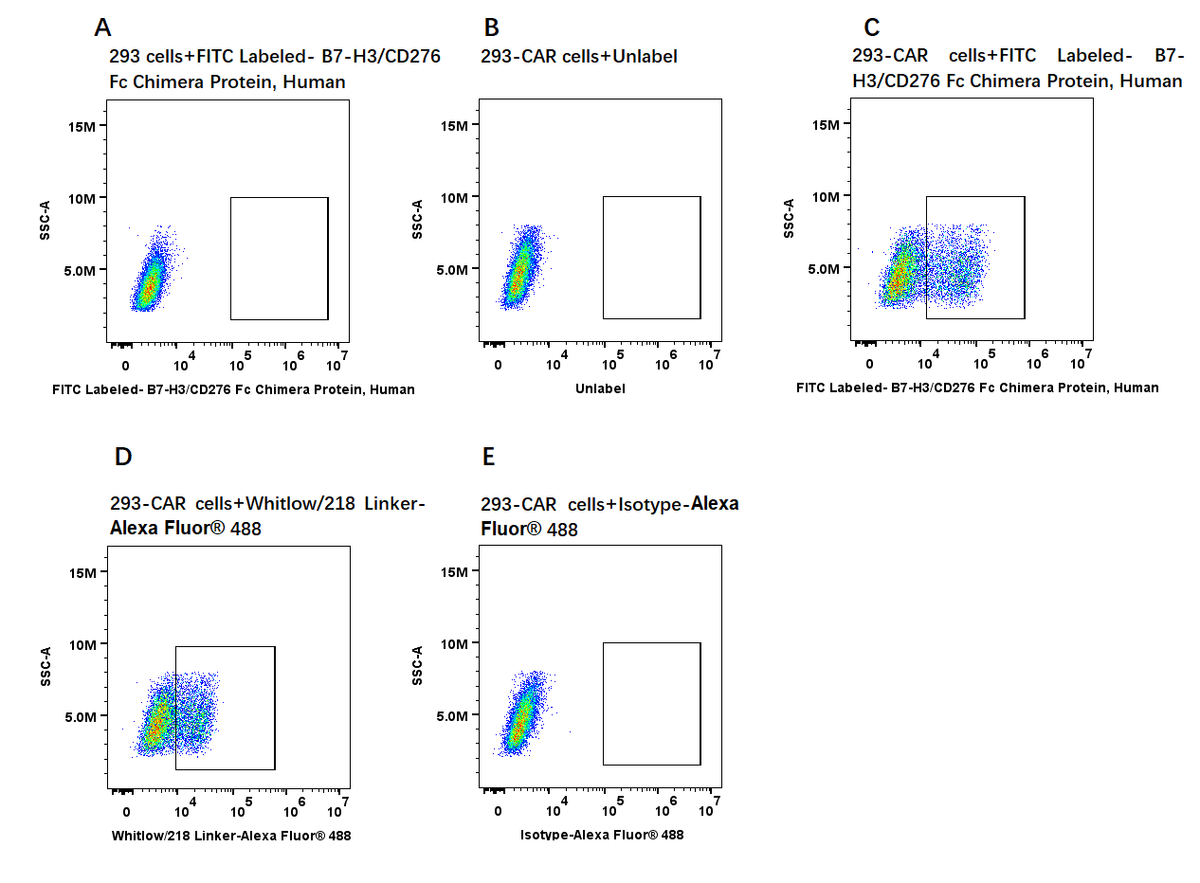
2e5 of transient transfected anti- CD276 ScFv CAR-293 cells were stained with 0.1ug FITC-Labeled B7-H3/CD276 Fc Chimera Protein, Human, (Cat. No. UA011268) and unlable respectively (Fig. C and B), and non-transfected 293 cells were used as a control (Fig. A). FITC signal was used to evaluate the binding activity.
2e5 of transient transfected anti- CD276 ScFv CAR-293 cells were stained with isotype and Whitlow/218 Linker-Alexa Fluor® 488 (Fig. D and E). Alexa Fluor® 488 signal was used to evaluate the binding activity.
FITC-Labeled B7-H3/CD276 Fc Chimera Protein, Human
FITC-Labeled B7-H3/CD276 Fc Chimera Protein, Human
Price:
Regular price
$390 USD
Regular price
Sale price
$390 USD
Unit price
per
For shipping services or bulk orders, you may request a quotation.
Secure checkout with

View full details
Product Details
Product Details
Product Specification
| Species | Human |
| Synonyms | B7 homolog 3 (B7-H3), CD276, B7 homolog 3 |
| Accession | Q5ZPR3-2 |
| Amino Acid Sequence | Leu29-Pro245 with Human IgG1 Fc at the C-Terminus |
| Expression System | HEK293 |
| Molecular Weight | 60-70kDa |
| Conjugation | FITC |
| Tag | Human IgG1 Fc |
| Physical Appearance | Liquid |
| Storage Buffer | PBS, pH7.4 |
| Stability & Storage |
· 12 months from date of receipt stored at --20 to -80℃. · 1 week, 2 to 8℃ under sterile conditions · Recommend to aliquot the protein into smaller quantities for optimal storage. · Please avoid repeated freeze-thaw cycles. |
| Reference | 1. A I Chapoval et al. B7-H3: a costimulatory molecule for T cell activation and IFN-gamma production.Nat Immunol. 2001 Mar;2(3):269-74. |
Background
B7 homolog 3 (B7-H3, CD276) is a member of the B7 family of cell surface ligands that regulate T cell activation and immune responses. B7-H3 protein contains two extracellular Ig-like V-type domains and two IgG-like C2-type domains, a transmembrane domain, and a short intracellular domain. Early research examining the biological process of B7-H3 suggested that B7-H3 is a positive regulator of T cell response. Subsequent research studies indicated that B7-H3 is a negative regulator of T cell response, and that the protein inhibits T cell proliferation. One possibility is that B7-H3 interacts with two distinct sets of receptors, resulting in seemingly opposite biological outcomes. B7-H3 is expressed by antigen presenting cells, activated T cells, and a few normal tissues, including placenta and prostate. Expression of B7-H3 is seen in several cancer types, including prostate, breast, colon, lung, and gastric cancers, and in endothelial cells from tumor associated vasculature.
Guidelines
Please conduct the experiments strictly according to the recommended dosage. If the grouping is not clear, the recommended dosage can be increased by 2 to 5 times.
Picture
Picture
FC