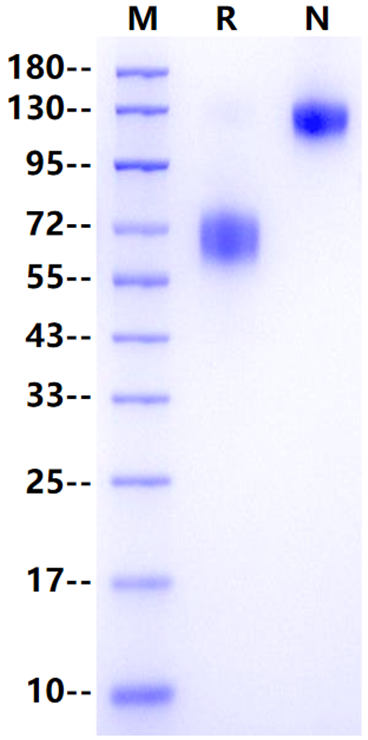
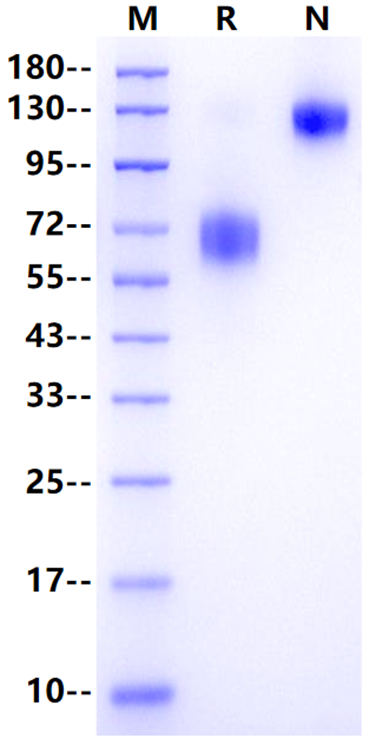
1μg (R: reducing condition, N: non-reducing
condition).
FCER1a Fc Chimera Protein, Mouse
FCER1a Fc Chimera Protein, Mouse
Price:
Regular price
$604 USD
Regular price
Sale price
$604 USD
Unit price
per
For shipping services or bulk orders, you may request a quotation.
Secure checkout with

View full details
Product Details
Product Details
Product Specification
| Species | Mouse |
| Synonyms | FCE1A, FcERI, Fc epsilon RI α |
| Accession | P20489-1 |
| Amino Acid Sequence | Ala24-Gln204, with C-hFc |
| Expression System | HEK293 |
| Molecular Weight | 60-80kDa (Reducing) |
| Purity | >95% by SDS-PAGE & SEC-HPLC |
| Endotoxin | <0.1EU/μg |
| Conjugation | Unconjugated |
| Tag | Human Fc Tag |
| Physical Appearance | Lyophilized Powder |
| Storage Buffer | PBS, pH7.4. |
| Reconstitution | Reconstitute at 0.1-1 mg/ml according to the size in ultrapure water after rapid centrifugation. |
| Stability & Storage | · 12 months from date of receipt, lyophilized powder stored at -20 to -80℃. · 3 months, -20 to -80℃ under sterile conditions after reconstitution. · 1 week, 2 to 8℃ under sterile conditions after reconstitution. · Please avoid repeated freeze-thaw cycles. |
| Reference | 1. Shimizu, A. et al. (1988) Proc. Natl. Acad. Sci. USA 85:1907. |
Background
Fc epsilon RI α, also known as FCER1A, is the αsubunit of immunoglobulin receptor (IgE receptor). IgE receptor consists of oneα subunit, one β subunit and two γ subunits. The α subunit includesextracellular domain and transmembrane domain, and the extracellular regioncontains two immunoglobulin-like domains, in which the proximal membrane end isthe binding region to IgE Fc, and the other end is related to high affinity.The α subunit contains seven N-chain glycosylation sites, which can guide thecorrect folding of the α-chain. β subunit is divided into transmembrane regionand intracellular region, which is a four-time transmembrane molecule withimmune receptor tyrosine activation motif (ITAM). The γ subunits are connectedby disulfide bonds and each has a transmembrane region. Fc epsilon RI α firstinitiates anaphylaxis. Allergens act on mast cells through IgE and Fc epsilonRI α, activate chemical mast cells through signal transduction, releasevasoactive mediators such as histamine and bradykinin to causehypersensitivity, or pre-release Leucotrienes, leukotrienes and plateletactivating factors to cause inflammation.
Picture
Picture
SDS-PAGE