


FAP His Tag Protein, Human
FAP His Tag Protein, Human

Product Details
Product Details
Product Specification
| Species | Human |
| Synonyms | FAPA,SIMP,DPPIV,FAP alpha |
| Accession | Q12884 |
| Amino Acid Sequence | Leu26-Asp760, with N-8*His |
| Expression System | HEK293 |
| Molecular Weight | 80-90kDa |
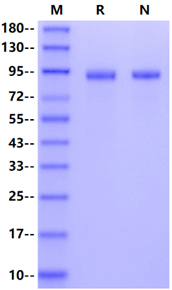
| Purity | >95% by SDS-PAGE |
| Endotoxin | <0.1EU/μg |
| Conjugation | Unconjugated |
| Tag | His Tag |
| Physical Appearance | Lyophilized powder |
| Storage Buffer | PBS, pH7.4 |
| Reconstitution | Reconstitute at 0.1-1 mg/ml according to the size in ultrapure water after rapid centrifugation. |
| Stability & Storage |
· 12 months from date of receipt, lyophilized powder stored at -20 to -80℃. · 3 months, -20 to -80℃ under sterile conditions after reconstitution. · 1 week, 2 to 8℃ under sterile conditions after reconstitution. · Please avoid repeated freeze-thaw cycles. |
| Reference |
1、Cheng J D. et al. (2005) Fibroblast activation protein overexpression confers an enhanced adherence and motility phenotype. Cancer Res. 65(1): 1326. 2、Kraman M. et al. (2010) Suppression of Antitumor Immunity by Stromal Cells Expressing Fibroblast Activation Protein-α. Science. 330(6005): 827-830. 3、Bauer S. et al. (2006) Fibroblast activation protein is expressed by rheumatoid myofibroblast-like synoviocytes. Arthritis Res Ther. 8(6): R171. |
Background
Neuropeptide-associated fibroblast activation protein (FAP) is a homodimeric integral membrane gelatinase belonging to the serine protease family. It is selectively expressed in reactive stromal fibroblasts of epithelial cancers, granulation tissue of healing wounds, and malignant cells of bone and soft tissue sarcomas. This protein is thought to be involved in the control of fibroblast growth or epithelial-mesenchymal interactions during development, tissue repair, and epithelial carcinogenesis. Alternatively spliced transcript variants encoding different isoforms have been found for this gene. Neuropeptide-associated fibroblast activation protein (FAP) may be an important risk factor for neurovascular metastasis in hepatocellular carcinoma. Analysis of The Cancer Genome Atlas (TCGA) database showed that FAP mRNA was highly expressed in most human tumor tissues. The HPA database then verified that FAP was highly expressed in tumor tissues following protein translation. Survival analysis then showed that the level of FAP expression significantly affected the overall survival (OS), progress free interval (PFI), and disease specific survival (DSS) of patients with hepatocellular carcinoma.
Protocol
Assay protocol
Principle: Measured by its ability to convert the substrate benzyloxycarbonyl-Gly-Pro-7-amido-4-methylcoumarin (Z-GP-AMC) to Z-Gly-Pro and 7-amino-4-methylcoumarin (AMC).
Materials
Assay Buffer: 50 mM Tris, 1 M NaCl, 1 mg/mL BSA, pH 7.5
FAP His Tag Protein, Human
Substrate: Z-Gly-Pro-AMC (Bachem, Catalog # I-1145)
96 ELISA Removable Plate, Black, High binding (GENEVER, Catalog # GMO2-96H)
Plate Reader (PerkinElmer, excitation 380 nm and emission 460 nm)
Produce
Dilute FAP to 0.4 μg/mL, 0.2 μg/mL in Assay Buffer.
Dilute Substrate to 100 μM in Assay Buffer.
Load 50 μL of 0.4 μg/mL, 0.2 μg/mL of FAP into a plate, and start the reaction by adding 50 μL of 100 μM Substrate. Include a Substrate Blank containing 50 μL of Assay Buffer and 50 μL of Substrate.
Read at excitation and emission wavelengths of 380 nm and 460 nm (top read), respectively, in kinetic mode for 5 minutes.
Calculate specific activity:
Specific Activity (pmol/min/µg) = |
Adjusted Vmax* (RFU/min) x Conversion Factor (pmol/RFU)** |
amount of enzyme (µg) |
*Adjusted for Substrate Blank
**Derived using calibration standard 7-Amino, 4-Methyl Coumarin (Enzo, Catalog # BML-KI107-0001).
Picture
Picture
SDS-PAGE
SEC-HPLC
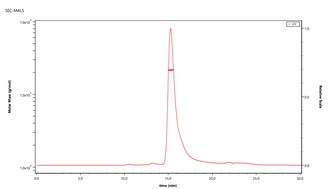
The purity of Human FAP, His Tag (Cat. No. UA010165) is more than 95% and the molecular weight of this protein is around 219 kDa verified by SEC-MALS.
ELISA
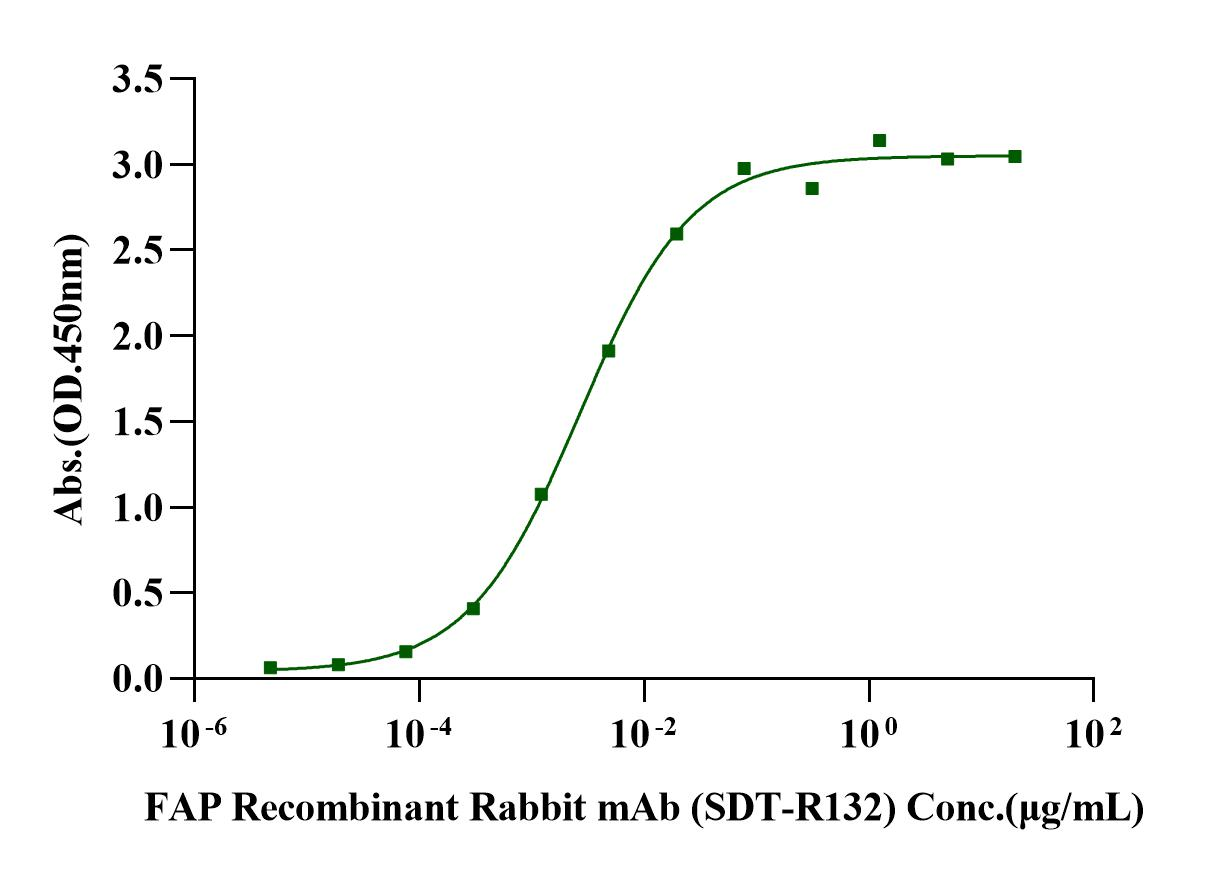
Immobilized FAP His Tag, Human (Cat. No. UA010165) at 1.0μg/mL (100μL/well) can bind FAP Recombinant Rabbit mAb (SDT-R132) (Cat. No. S0B2166) with EC50 of 2.15-3.34ng/mL.
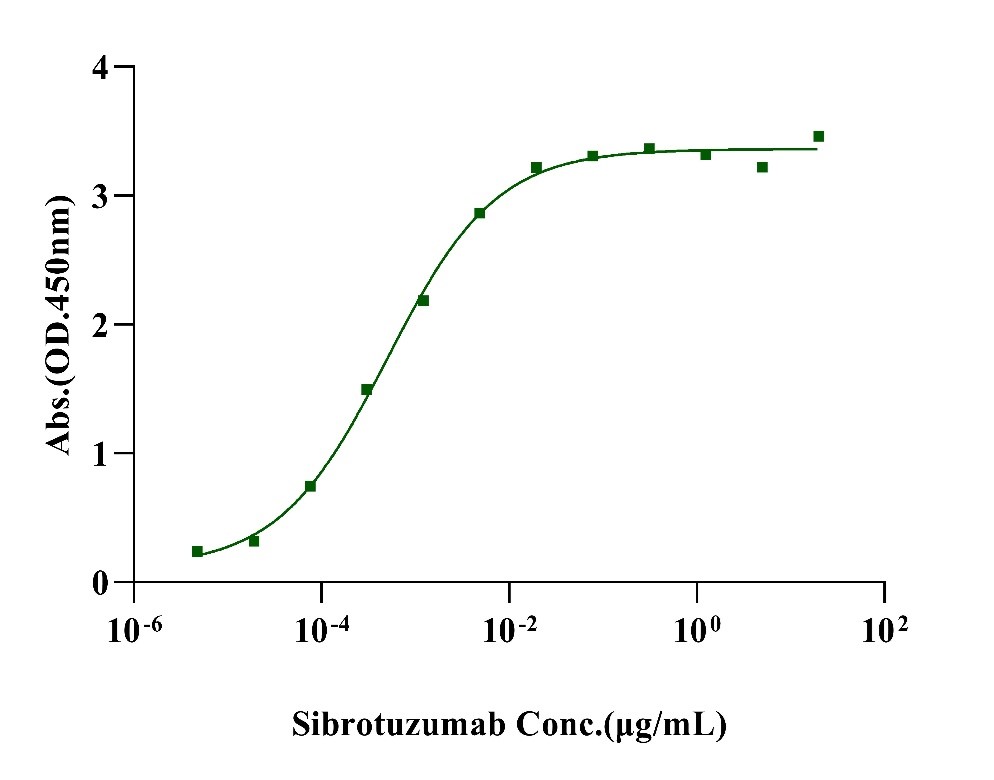
Immobilized FAP His Tag Protein, Human (Cat. No. UA010165) at 1.0μg/mL (100μL/well) can bind Sibrotuzumab with EC50 of 0.37-0.67ng/mL.


