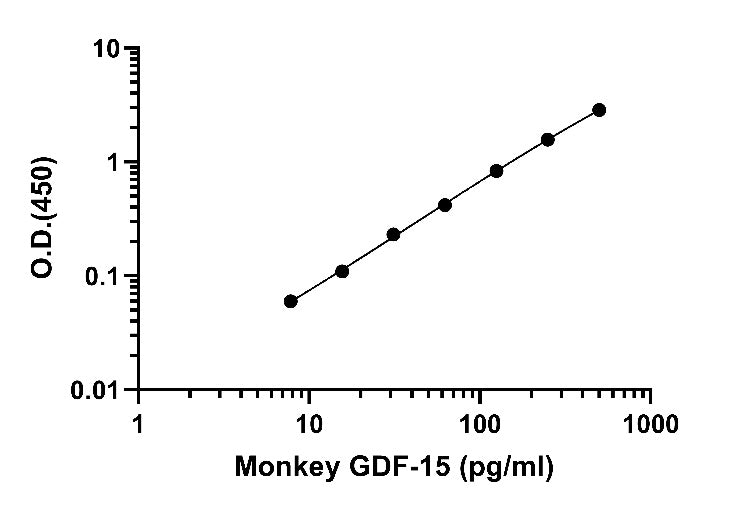
Standard curve
Example of Monkey GDF-15 standard curve in Assay Diluent #1.
Monkey GDF-15(Culture Medium) OneStep ELISA Kit
Monkey GDF-15(Culture Medium) OneStep ELISA Kit
Price:
Regular price
$333 USD
Regular price
Sale price
$333 USD
Unit price
per
For shipping services or bulk orders, you may request a quotation.
Secure checkout with

View full details
Product Details
Product Details
Product Specification
| Antigen | GDF-15 |
| Immunogen | Recombinant Protein |
| Antibody Type | Recombinant mAb |
| Reactivity | Mk |
| Purification | Protein A |
| Stability & Storage | 12 months from date of receipt / reconstitution, 2 to 8'C as supplied. |
Kit
| Precision | Intra-assay: 5.0%; Inter-assay: 7.8% |
| Sample type | Cell culture supernatant |
| Assay type | Sandwich (quantitative) |
| Sensitivity | 2.513 pg/mL |
| Range | 7.81 pg/mL – 500 pg/mL |
| Recovery | Cell culture supernatant: 90% |
| Assay time | 60 minutes |
| Species reactivity | Mk |
Background
Monkey GDF-15 is a stress-responsive cytokine belonging to the TGF-β superfamily, functionally conserved with human and rodent orthologs. It is primarily secreted by macrophages, epithelial cells, and tissues like the liver, skeletal muscle, and myocardium under pathological conditions such as inflammation, cellular stress, or metabolic disturbances. In non-human primates (e.g., rhesus macaques), GDF-15 signals through the GFRAL-RET receptor complex localized in the brainstem's area postrema and nucleus tractus solitarius, regulating appetite suppression and energy homeostasis. Recombinant monkey GDF-15 (∼19 kDa) has demonstrated pharmacological efficacy in reducing food intake and body weight (e.g., 4% weight loss in monkey studies) without observed nausea, supporting its therapeutic potential for obesity. Its physiological levels in serum/plasma, detectable via ELISA (sensitivity: 2.2–9.38 pg/mL), correlate with stress responses, endurance exercise, and pathologies like cachexia or cardiovascular disease. Cross-reactivity with human GDF-15 antibodies (100% sequence identity in C-terminal epitopes) further underscores its translational relevance in preclinical models.
Picture
Picture
ELISA
Leading Competitor comparison
Protocol Diagram