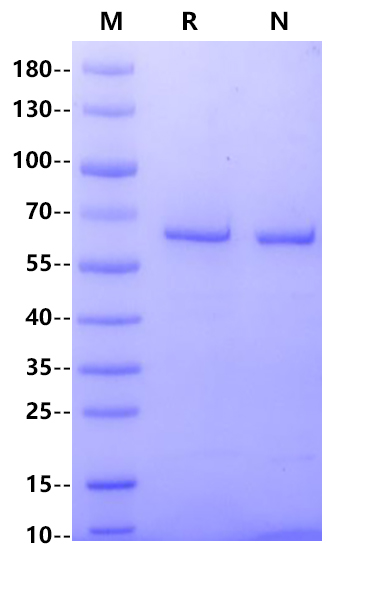
2μg (R: reducing condition, N: non-reducing condition).
IRF5 His Tag Protein, Human
IRF5 His Tag Protein, Human
Price:
Regular price
$185 USD
Regular price
Sale price
$185 USD
Unit price
per
For shipping services or bulk orders, you may request a quotation.
Secure checkout with

View full details
Product Details
Product Details
Product Specification
| Species | Human |
| Synonyms | IRF5 |
| Accession | Q13568-1 |
| Amino Acid Sequence | M1-Q498 with His Tag at the C-Terminus |
| Expression System | E.coli |
| Molecular Weight | 55-70kDa (Reducing) |
| Conjugation | Unconjugated |
| Tag | His Tag |
| Physical Appearance | Liquid |
| Storage Buffer | 50mM Tris, 150mM NaCl, pH7.5,1mM DTT, 10%Glycerol |
| Stability & Storage | Stable for 12 months upon stored at -80℃ from the date of receipt. And avoid repeated freeze-thaws cycles. |
| Reference | 1. Yu, X., et al. (2025). Interferon regulatory factor 5: a potential target for therapeutic intervention in inflammatory diseases. Frontiers in Immunology, 16, 1535823. |
Background
IRF5 (Interferon Regulatory Factor 5) is a core member of the IRF transcription factor family, playing a pivotal role in both innate and adaptive immunity. Encoded by the IRF5 gene on human chromosome 7 (UniProt: Q13568), IRF5 is expressed in macrophages, dendritic cells, monocytes, and B cells, and serves as a critical node downstream of Toll-like receptor (TLR) signaling, regulating the expression of type I interferons (IFN-α/β) and multiple proinflammatory cytokines (e.g., IL-12, IL-17, IL-23, TNFα).
Activation Mechanism and Structural Features: In resting cells, IRF5 exists as a monomeric autoinhibited form in the cytoplasm. Upon TLR activation, the adaptor protein TASL recruits IRF5, enabling its phosphorylation by IKBKB. Phosphorylated IRF5 then dimerizes, translocates to the nucleus, and associates with the coactivator CBP/p300 to initiate target gene transcription. Its DNA-binding domain spans residues 14-122 and contains the characteristic IRF tryptophan pentad repeat.
Picture
Picture
SDS-PAGE