Human Total IgG Kit (Wide Range) (HICA)
Human Total IgG Kit (Wide Range) (HICA)

Product Details
Product Details
Product Specification
| Stability & Storage | 2~8℃ Store away from light.6months; after reconstituting the calibrator, it can be aliquoted and stored at-20℃ for three months, avoiding repeated freeze-thaw cycles. |
Background
Human immunoglobulinG (Human Immunoglobulin G, IgG) is an antibody secreted and released by plasma cells (B cells). It is the most common type of antibody in the bloodstream and the most abundant immunoglobulin in human serum, accounting for approximately 75% of total serum immunoglobulins. The molecular weight of IgG is about 150 kDa, and it typically exists as a tetrameric structure composed of two identical heavy chains and two identical light chains linked by inter-chain disulfide bonds. IgG serves as a major effector molecule in humoral immune responses. Based on differences in the amino acid composition and structure of the hinge region, IgG can be divided into four subclasses: IgG1 (approximately 66%), IgG2 (approximately 23%), IgG3 (approximately 7%), and IgG4 (approximately 4%). IgG is distributed in blood and tissue fluids, where it exerts various immune functions, including neutralizing pathogens, activating complement, opsonizing phagocytosis, and mediating antibody-dependent cell-mediated cytotoxicity. It plays a central role in anti-infection immunity and immunological memory and can cross the placenta to provide passive immune protection to newborns. Clinically, IgG is an important indicator for assessing humoral immunity, vaccine efficacy, and the mechanisms of autoimmune diseases, and it is widely used in disease mechanism research, drug efficacy evaluation, and biomarker development. This kit…For the quantitative in vitro detection of total [substance] in cell culture supernatants, serum, plasma, and other samples.IgG concentration provides a sensitive, specific, and efficient tool suitable for basic medical research and drug screening applications.
Principle of the test:

This kit employs a competitive homogeneous chemiluminescence assay.Homogeneous Immuno Chemiluminescence Assay (HICA) for the detection of human IgG, which is easy to perform and requires no washing steps.
The detection system includes two types of microspheres: donor microspheres conjugated with antibodies.Human IgG antibody, receptor microspheres conjugated with Human IgG. During the reaction, free Human IgG in the sample competes with the Human IgG conjugated to the receptor microspheres for binding to the antibody on the donor microspheres. When the antibody on the donor microsphere binds to Human IgG on the receptor microsphere and the distance between the two microspheres is less than 200 nm, the singlet oxygen generated by light excitation of the donor microsphere can be transferred to the receptor microsphere and trigger chemiluminescence; the higher the concentration of Human IgG in the sample, the more freeHuman IgG occupies the antibody on the donor microsphere, resulting in fewer bindings between the receptor microsphere and the antibody on the donor microsphere, and thus a weaker luminescent signal; conversely,Huthe lower the concentration of Human IgG, the stronger the signal. Therefore, the intensity of the chemiluminescent signal is negatively correlated with the concentration of Human IgG in the sample, enabling quantitative analysis. This method features simple operation, rapid reaction, and high sensitivity.
Components
Name |
Specification |
Component Specification |
Test ReagentR1 |
100 Tests |
6μl /per tube ×1 |
500 Tests |
30μl /per tube ×1 |
|
Test ReagentR2 |
100 Tests |
6μl /per tube ×1 |
500 Tests |
30μl /per tube ×1 |
|
Calibrator |
100 Tests |
300μglyophilized powder ×1 |
500 Tests |
300μglyophilized powder ×5 |
|
Reagent Diluent |
100 Tests |
2.2 mL/per bottle ×1 |
500 Tests |
11 mL/per bottle ×1 |
|
Calibrator Diluent |
100 Tests |
1 mL/per tube ×1 |
500 Tests |
1 mL/per tube ×5 |
Note: It is recommended to use microplates (384shallow wells or384,96well plates, white or gray)
Protocol
Sample requirements
1.To remove impurities from the sample, the sample must be centrifuged prior to analysis.2000 ×g,10minutes).
2.If the measured concentration of a sample exceeds the highest value on the standard curve, it should be appropriately diluted (using negative serum is recommended) and retested to ensure that the results fall within the valid measurement range.
Testing process
2.1Preparation of calibration standard gradient samplesAdopt 100muLReconstitute with deionized water.300The μg lyophilized calibrator is C.10, then dilute the reconstituted lyophilized calibrator C with the calibrator diluent.10Perform gradient dilution, calibrator C.1This is the calibrator diluent; the recommended dilution scheme is shown in the table below:
Gradient |
Concentration (mug/mL) |
Higher-level calibrator(microliters) |
Diluent (μL) |
C10 |
3000 |
- |
- |
C9 |
1000 |
30 μL C10 |
60 |
C8 |
300 |
30μL C9 |
70 |
C7 |
100 |
30μL C8 |
60 |
C6 |
30 |
30μL C7 |
70 |
C5 |
10 |
30μL C6 |
60 |
C4 |
3 |
30μL C5 |
70 |
C3 |
1 |
30μL C4 |
60 |
C2 |
0.3 |
30μL C3 |
70 |
C1 |
0 |
- |
- |
2.2Testing procedure:
|
Testing procedure 25℃One-step methodTesting | |
Sample addition |
1.Take2µL of sampleAdd384microplate; 2.AfterR1 and R2 are each sonicated for 5 seconds or vortexed, then diluted 200-fold with the reagent diluent and mixed, they become the working reagents respectively(Note: Test reagent R1 will react directly with R2; they must be diluted separately and never pre-mixed).; 3.First add to the sampleAdd 9μLdilutedR1After that, add 9 μLdiluted R2. |
Incubate |
in a microplate shakerat 800 r/min, 25°Cincubatefor 60 min |
read |
instrument reading,protect from light/green light |
* Note: R1 and R2must be sonicated for 5 s or vortexed before use; prepare fresh and use immediately, and keepprotected from light/green light
When adding samples, keep the pipette tip close to the bottom of the well to avoid bubbles, as bubbles can affect the readings.
Test reagentsR1 and R2 will react directly with each other, so they must be diluted separately—never mix them in advance. Please follow the specified order of addition strictly.
The reaction system can be adjusted proportionally according to experimental needs.
III. Performance Testing
3.1Example of a complete standard curve:

3.2Performance parameter verification:
LOB:Repeat testing20times on calibratorC1, calculate the mean signal andSD, then use the standard curve to calculatemean signal-2timesSDThe corresponding concentration value is the limit of detection (LOD).B.
Matrix |
Blank Limit(ng/mL) |
Buffer solution |
206.0 |
Dynamic range (Dynamic range):0.3 – 3000mug/mL.
Precision (Precision):
Intra-precision (Intra-Precision): In the same experimentOn the orifice plate, using known low,China,Each high-concentration sample was tested in triplicate.1Zero times, to evaluate the intra-assay precision of this assay.schoolBoth the reference product and the sampleTest using different processes.The coefficient of variation (%CV) for the test results of samples at each concentration was less than 10%, indicating that the method exhibits good reproducibility within the same batch..
Matrix |
Precision |
||
Low concentration |
Medium concentration |
High concentration |
|
Buffer solution |
2% |
3% |
3% |
Inter-plate precision (Inter-Precision): In 5In the next independent experiment, known low levels were tested separately,China,High-concentration samples are being tested. Settings5The test results for samples at each concentration all showed low coefficients of variation (CV < 10%), indicating that the method has good reproducibility across different batches.
Matrix |
Intermediate precision |
||
Low concentration |
Medium concentration |
High concentration |
|
Buffer |
5% |
6% |
4% |
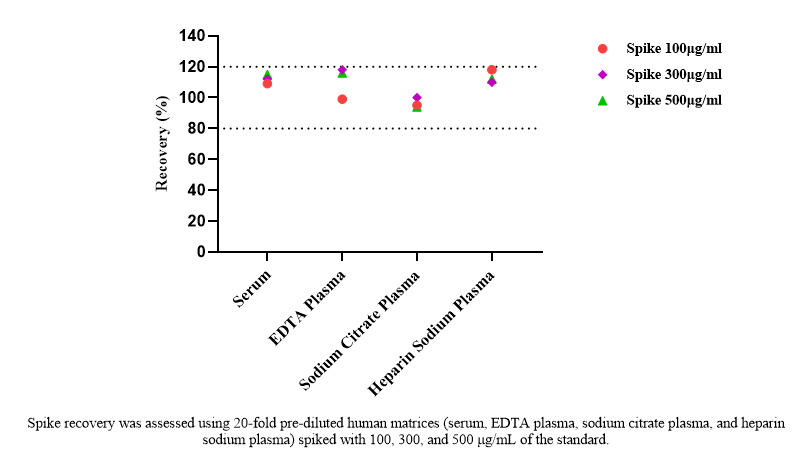
Accuracy (Recovery):
Standard solutions of IgG at low, medium, and high concentrations were added to different matrices, and their average recovery rates were tested twice.IgGMatrix
Recovery rate |
Low concentration |
||
Medium concentration |
High concentration |
Calibrator diluent |
|
93% |
94% |
97% |
Culture supernatant |
112% |
109% |
100% |
30% |
20XSerum |
109% |
112% |
115% |
20XEDTAPlasma |
99% |
118% |
116% |
20XSodium citrate serum |
95% |
100% |
94% |
20XHeparin sodium serum |
118% |
110% |
112% |

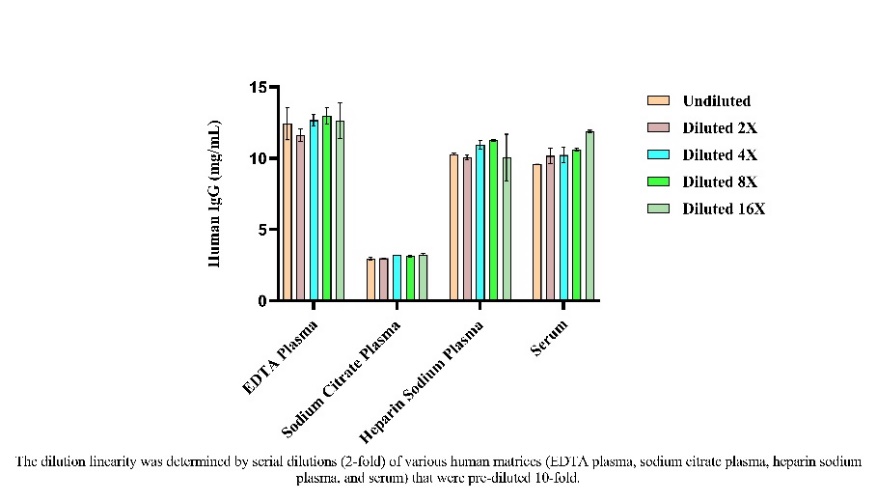
Dilution linearity (Dilution linearity):
Dilute separately10The serum and plasma were diluted in a gradient after being multiplied by a factor, and the dilution linearity was evaluated.
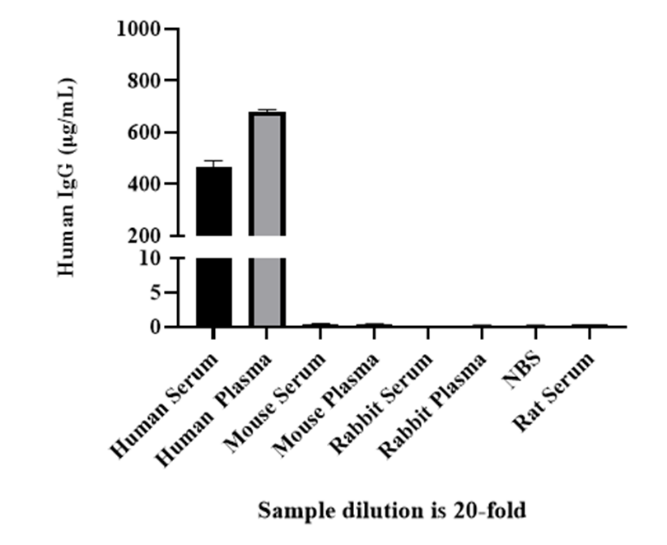
Specificity (Specificity:):
Dilute samples from different species separately.Detection was performed after 20-fold dilution, and the results indicated that the kit exhibited no cross-reactivity in the following species.
Guidelines