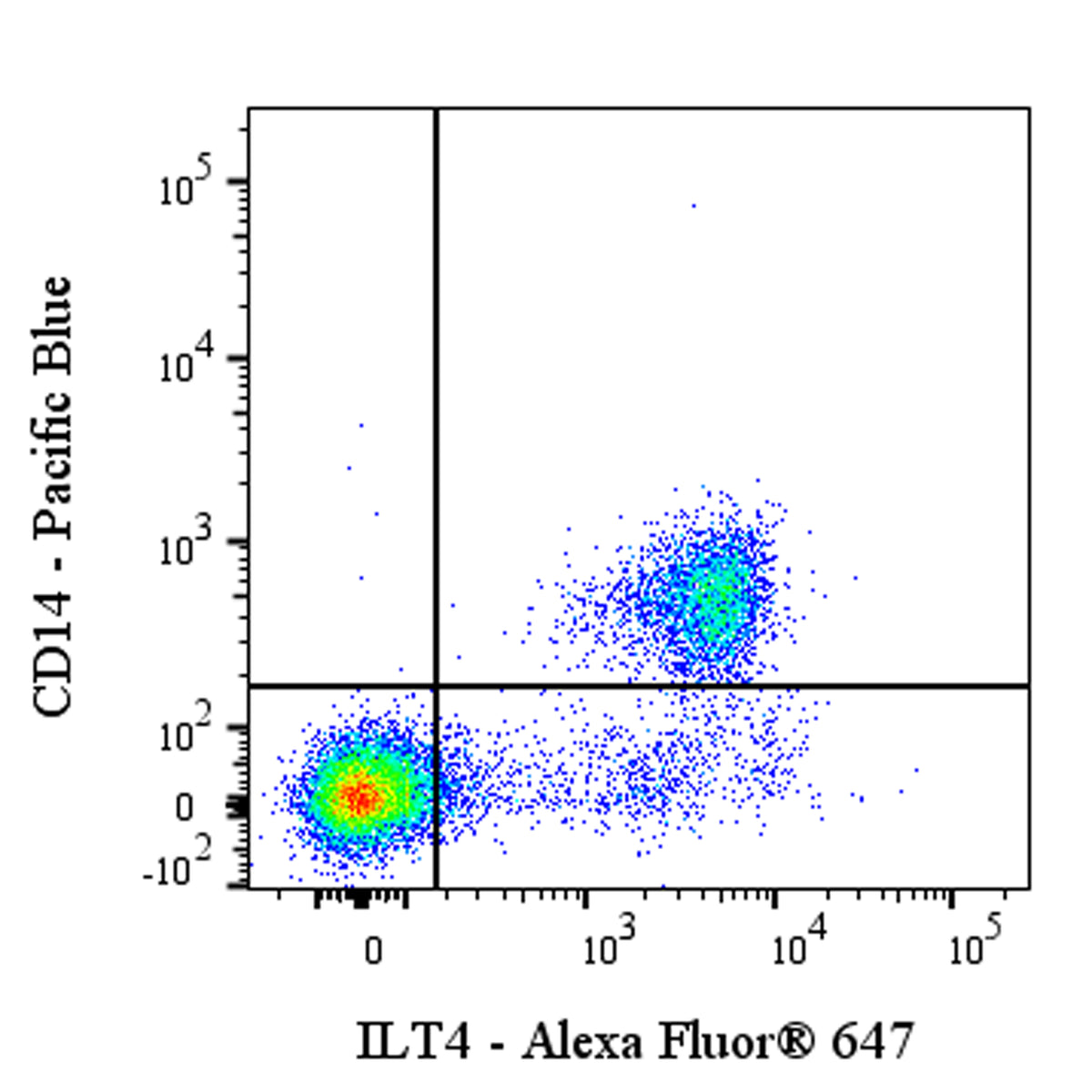
Flow cytometric analysis of human ILT4 expression on Human PBMCs (human peripheral blood mononuclear cells). Human PBMCs were stained with SDT Pacific Blue Mouse Anti-Human CD14 Antibody (S0B5209) and SDT Alexa Fluor® 647 Rabbit Anti-Human ILT4(CD85d) Antibody at 5 μl/test. Flow cytometry and data analysis were performed using BD FACSymphony™ A1 and FlowJo™ software.
Alexa Fluor® 647 Rabbit Anti-Human ILT4 (CD85d) Antibody (S-281-50)
Alexa Fluor® 647 Rabbit Anti-Human ILT4 (CD85d) Antibody (S-281-50)
Price:
Regular price
$180 USD
Regular price
Sale price
$180 USD
Unit price
per
For shipping services or bulk orders, you may request a quotation.
Secure checkout with

View full details
Product Details
Product Details
Product Specification
| Host | Rabbit |
| Antigen | ILT4 (CD85d) |
| Immunogen | Recombinant Protein |
| Location | Cell membrane |
| Accession | Q8N423 |
| Clone Number | S-281-50 |
| Antibody Type | Recombinant mAb |
| Isotype | IgG |
| Isotype Control | S0B8021 |
| Application | FCM |
| Reactivity | Hu |
| Positive Sample | Human PBMC |
| Purification | Protein A |
| Concentration | 0.2 mg/ml |
| Conjugation | Alexa Fluor® 647 |
| Physical Appearance | Liquid |
| Storage Buffer | PBS, 1% BSA, 0.09% sodium azide |
| Stability & Storage | 12 months from date of receipt / reconstitution, 2 to 8 °C as supplied |
Dilution
| application | dilution | species |
| FCM | 5μl per million cells in 100μl volume | Hu |
Background
ILT4, also known as LILRB2 or CD85d, is a type I transmembrane inhibitory receptor primarily expressed on the surface of myeloid immune cells, including monocytes, macrophages, and dendritic cells. Structurally, its extracellular region contains four immunoglobulin-like domains, which enable it to recognize and bind to classical or non-classical MHC class I molecules such as HLA-G, while its intracellular region carries immunoreceptor tyrosine-based inhibitory motifs (ITIMs). Upon receptor engagement, these motifs recruit SHP-1 phosphatases to transmit inhibitory signals into the cell, thereby negatively regulating immune cell activation. Under physiological conditions, this mechanism helps control excessive inflammatory responses and maintain immune tolerance—for instance, at the maternal-fetal interface, it protects the fetus from maternal immune attack through binding to HLA-G. However, within the tumor microenvironment, the role of ILT4 becomes "diverted": tumor cells aberrantly overexpress ILT4, which not only directly promotes cancer cell proliferation, migration, and invasion, but also fosters a potent immunosuppressive microenvironment by inducing macrophage polarization toward the pro-tumor M2 phenotype and impeding CD8+ T cell infiltration while inducing their exhaustion. Based on these pro-tumorigenic mechanisms, ILT4 has emerged as a novel and promising target for cancer immunotherapy, and clinical studies of blocking antibodies targeting ILT4 are actively underway.
Picture
Picture
FC