2× Fidelis Master Mix
2× Fidelis Master Mix
Price:
Regular price
$195 USD
Regular price
Sale price
$195 USD
Unit price
per
For shipping services or bulk orders, you may request a quotation.
Secure checkout with

View full details
Product Details
Product Details
Product Specification
| Stability & Storage | Store at -25 ~ -15℃ for 1 year |
| Reference |
Protocol
1.System Preparation
All operations should be performed on ice throughout the entire process. After thawing, thoroughly mix each component and promptly return it to -20°C storage after use.
-20°C storage.
Components |
50µL systema |
Final concentration |
Template DNAb |
XµL |
≤ 200 ng |
2× Fidelis Master Mix |
25µL |
1× |
Forward primer (10µM) |
1µL |
0.2 µM (0.1–0.5 µM optional) |
Reverse primer (10µM) |
1µL |
0.2 µM (0.1–0.5 µM optional) |
RNase-freedH2O |
Adjust to 50µL |
- |
a. The reaction volume can be adjusted between 10 and 50 μL. For volumes other than 50 μL, reagents should be diluted proportionally. Reaction volumes greater than 50 μL are not recommended;
b. The optimal reaction concentration varies depending on the template; the following table shows the recommended template usage for a 50 μL reaction system:
<1 kb |
1-10 kb |
>10 kb |
|
Plasmid or viral DNA |
100 pg-100 ng |
100 pg-100 ng |
10 ng-100 ng |
cDNA |
1 – 5 μL (not exceeding 1/10 of the total PCR reaction volume) |
||
c. After preparation, gently tap the bottom of the tube to mix thoroughly and briefly centrifuge; avoid vigorous vortexing.
2.Reaction program
Cycle steps |
Temperature |
Time |
Number of cycles |
Pre-denaturationa |
95℃ |
2 min |
1 |
Denaturationb |
98℃ |
20 sec |
25-35d |
Annealingc |
58-72℃ |
10-15 sec |
|
Extension |
68/72℃ |
30-60 sec/kb |
|
Final extension |
72℃ |
5-10 min |
1 |
Hold |
12℃ |
∞ |
- |
a. Pre-denaturation conditions: For simple plasmids/λDNA, set to 95°C for 2 minutes; for complex genomic DNA, we recommend 95°C for 3–5 minutes.
b. Denaturation conditions: The standard recommendation is 98°C for 20 seconds; if the amplified fragment is >10 kb, it is advised to shorten the denaturation time to 98°C for 5–10 seconds to minimize high-temperature thermal damage.
c. Annealing temperature: Under high-fidelity optimization, the primer annealing kinetics of the reaction system may be slightly altered. We recommend setting the annealing time to 10–15 seconds. For the first experiment, it is recommended to use a temperature gradient to determine the optimal annealing temperature.
d. Number of cycles: To maintain the highest fidelity, it is recommended to limit the number of cycles to ≤25–35 cycles.
3.PCR procedure for templates with high GC content and difficult templates
When the GC content of the template amplicon is >60% or it has a complex secondary structure, it is recommended to adjust the reaction as follows: add a cosolvent—DMSO—to the standard reaction mixture.
The amount added should be 1–4 μL (resulting in a final concentration of 2%–8% in a 50 μL system; it is recommended to test incrementally in 1% steps).
(Note: Excessively high concentrations of the cosolvent may slightly reduce enzyme fidelity; therefore, its use is advised only for challenging templates.)
Guidelines
a. On-ice operations: The 2× Fidelis Master Mix is a hot-start enzyme system; although it allows for room-temperature preparation, performing operations on ice can yield exceptionally uniform experimental results.
Picture
Picture
Bioactivity
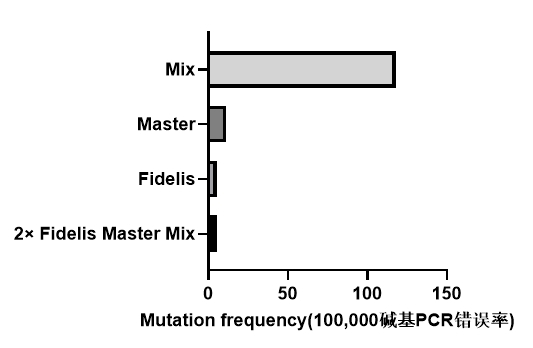
1.Fidelity Assay via Colony Sequencing:Using a plasmid as a template, the antibody heavy chain gene was amplified, and the resulting PCR products were cloned into a plasmid vector via homologous recombination. Subsequently, 288 positive clones were picked and sequenced. The results demonstrated that 2× Fidelis Master Mix exhibited fidelity equivalent to that of the leading competitor. The fidelity was approximately 90-fold higher than that of Taq DNA Polymerase, with virtually no mismatch mutations introduced during PCR amplification.
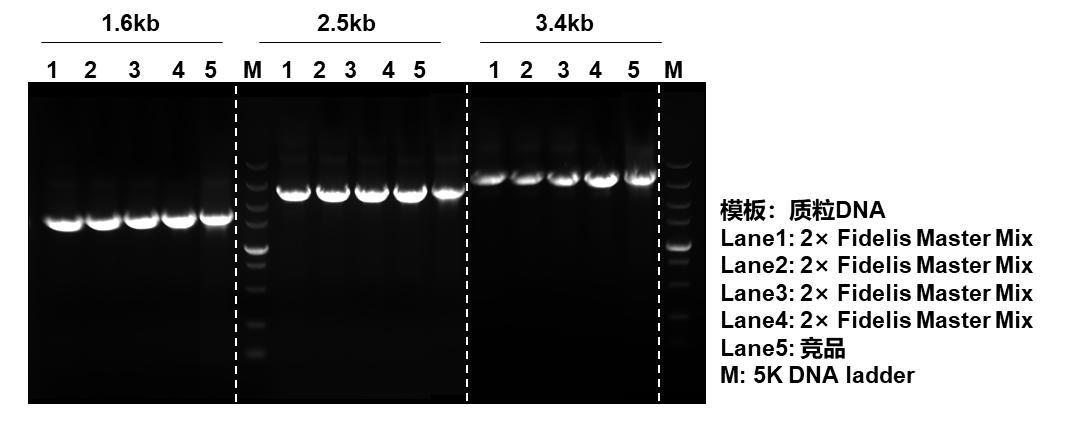
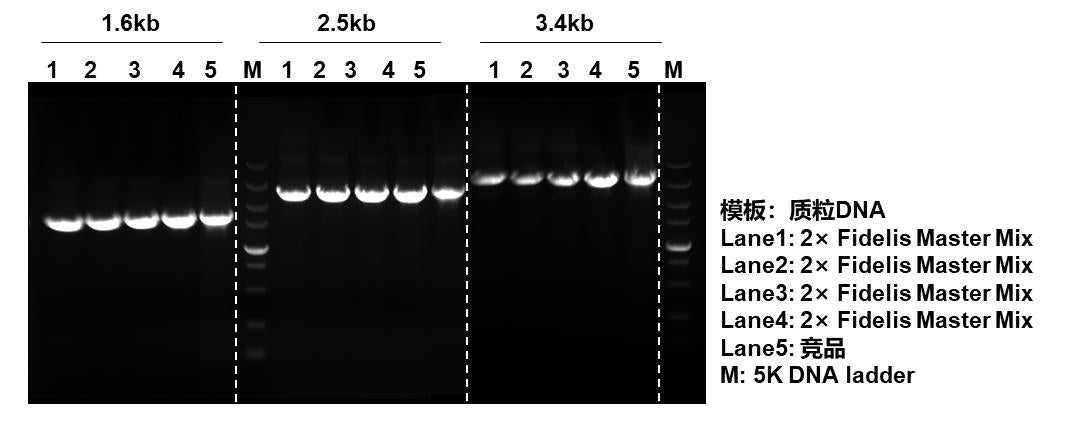
2.Amplification Across Various Fragment Lengths:Target genes of various lengths were amplified with 2× Fidelis Master Mix and competitor enzymes. PCR reactions were performed for 35 cycles under the recommended conditions for each enzyme. The results demonstrated that 2× Fidelis Master Mix matched the amplification efficiency of the competitor, consistently yielding sharp and robust target bands.