WB result of Phospho-STAT1(Ser727) Recombinant Rabbit mAb
Primary antibody: Phospho-STAT1(Ser727) Recombinant Rabbit mAb at 1/10000 dilution
Primary antibody incubation conditions: overnight at 4°C
Lane 1: untreated 293T whole cell lysate 30 µg
Lane 2: 293T treated with 100 mj/cm2 UV then recovery for 2 hours whole cell lysate 30 µg
Secondary antibody: Goat Anti-rabbit IgG (H+L), HRP conjugated at 1/10000 dilution
Predicted MW: 87 kDa
Observed MW: 97 kDa
Phospho-STAT1 (Ser727) Recombinant Rabbit mAb
Phospho-STAT1 (Ser727) Recombinant Rabbit mAb
Price:
Regular price
$100 USD
Regular price
Sale price
$100 USD
Unit price
per
For shipping services or bulk orders, you may request a quotation.
Secure checkout with

View full details
Product Details
Product Details
Product Specification
| Host | Rabbit |
| Antigen | Phospho-STAT1(Ser727) |
| Synonyms | Signal transducer and activator of transcription 1-alpha/beta; STAT1 |
| Immunogen | Synthetic Peptide |
| Location | Nucleus |
| Accession | P42224 |
| Antibody Type | Recombinant mAb |
| Isotype | IgG |
| Application | WB, IHC-P |
| Reactivity | Hu, Ms, Rt |
| Purification | Protein A |
| Concentration | 0.6 mg/ml |
| Conjugation | Unconjugated |
| Physical Appearance | Liquid |
| Storage Buffer | PBS, 40% Glycerol, 0.05% BSA, 0.02% sodium azide |
| Stability & Storage | 12 months from date of receipt / reconstitution, -20 °C as supplied |
Dilution
| application | dilution | species |
| WB | 1:10000-1:20000 | Hu, Ms, Rt |
| IHC-P | 1:500 | Hu, Ms, Rt |
Background
Phospho-STAT1(Ser727) refers to the modified form of the transcription factor STAT1 following phosphorylation at serine residue 727 within its C-terminal transactivation domain. Unlike Tyr701 phosphorylation, which primarily drives STAT1 dimerization, nuclear translocation, and DNA binding, Ser727 phosphorylation does not determine whether STAT1 enters the nucleus but instead regulates the strength of its transcriptional activation, representing a key step for STAT1 to achieve maximal transcriptional activity. This site can be phosphorylated by multiple kinases: upon interferon-γ stimulation, chromatin-bound CDK8 and CaMKII are involved in Ser727 phosphorylation; under conditions such as LPS, TNF-α, ultraviolet radiation, osmotic stress, or TLR signaling activation, pathways including p38 MAPK and ERK1/2 can also mediate phosphorylation at this site. Ser727 phosphorylation generally promotes the recruitment of coactivators such as CBP/p300 by STAT1, enhancing the expression of interferon-stimulated genes, inflammation-related genes, and antiviral genes. It can also facilitate STAT1 SUMOylation and its interaction with PIAS proteins, thereby further modulating its transcriptional activity. Functionally, Phospho-STAT1(Ser727) participates in macrophage activation, antiviral defense, inflammatory responses, apoptosis, and autoimmune reactions; in autoimmune disease models such as systemic lupus erythematosus, phosphorylation at this site can promote autoreactive B cells and autoantibody production. Therefore, it is commonly used as an important molecular marker for assessing STAT1 transcriptional activation status, interferon signaling intensity, and the activation of inflammatory or stress pathways.
Picture
Picture
Western Blot
WB result of Phospho-STAT1(Ser727) Recombinant Rabbit mAb
Primary antibody: Phospho-STAT1(Ser727) Recombinant Rabbit mAb at 1/10000 dilution
Primary antibody incubation conditions: overnight at 4°C
Lane 1: untreated C6 whole cell lysate 30 µg
Lane 2: C6 treated with 40 mj/cm2 UV then recovery for 30 minutes whole cell lysate 30 µg
Secondary antibody: Goat Anti-rabbit IgG (H+L), HRP conjugated at 1/10000 dilution
Predicted MW: 87 kDa
Observed MW: 100 kDa
Immunohistochemistry
IHC shows positive staining in paraffin-embedded human colon. Anti- Phospho-STAT1(Ser727) antibody was used at 1/500 dilution, followed by a HRP Polymer for Rabbit IgG (ready to use). Counterstained with hematoxylin. Heat mediated antigen retrieval with Tris/EDTA buffer pH9.0 was performed before commencing with IHC staining protocol.
IHC shows positive staining in paraffin-embedded human kidney. Anti- Phospho-STAT1(Ser727) antibody was used at 1/500 dilution, followed by a HRP Polymer for Rabbit IgG (ready to use). Counterstained with hematoxylin. Heat mediated antigen retrieval with Tris/EDTA buffer pH9.0 was performed before commencing with IHC staining protocol.
IHC shows positive staining in paraffin-embedded human colon cancer. Anti- Phospho-STAT1(Ser727) antibody was used at 1/500 dilution, followed by a HRP Polymer for Rabbit IgG (ready to use). Counterstained with hematoxylin. Heat mediated antigen retrieval with Tris/EDTA buffer pH9.0 was performed before commencing with IHC staining protocol.
IHC shows positive staining in paraffin-embedded human lung cancer. Anti- Phospho-STAT1(Ser727) antibody was used at 1/500 dilution, followed by a HRP Polymer for Rabbit IgG (ready to use). Counterstained with hematoxylin. Heat mediated antigen retrieval with Tris/EDTA buffer pH9.0 was performed before commencing with IHC staining protocol.
IHC shows positive staining in paraffin-embedded mouse colon. Anti- Phospho-STAT1(Ser727) antibody was used at 1/500 dilution, followed by a HRP Polymer for Rabbit IgG (ready to use). Counterstained with hematoxylin. Heat mediated antigen retrieval with Tris/EDTA buffer pH9.0 was performed before commencing with IHC staining protocol.
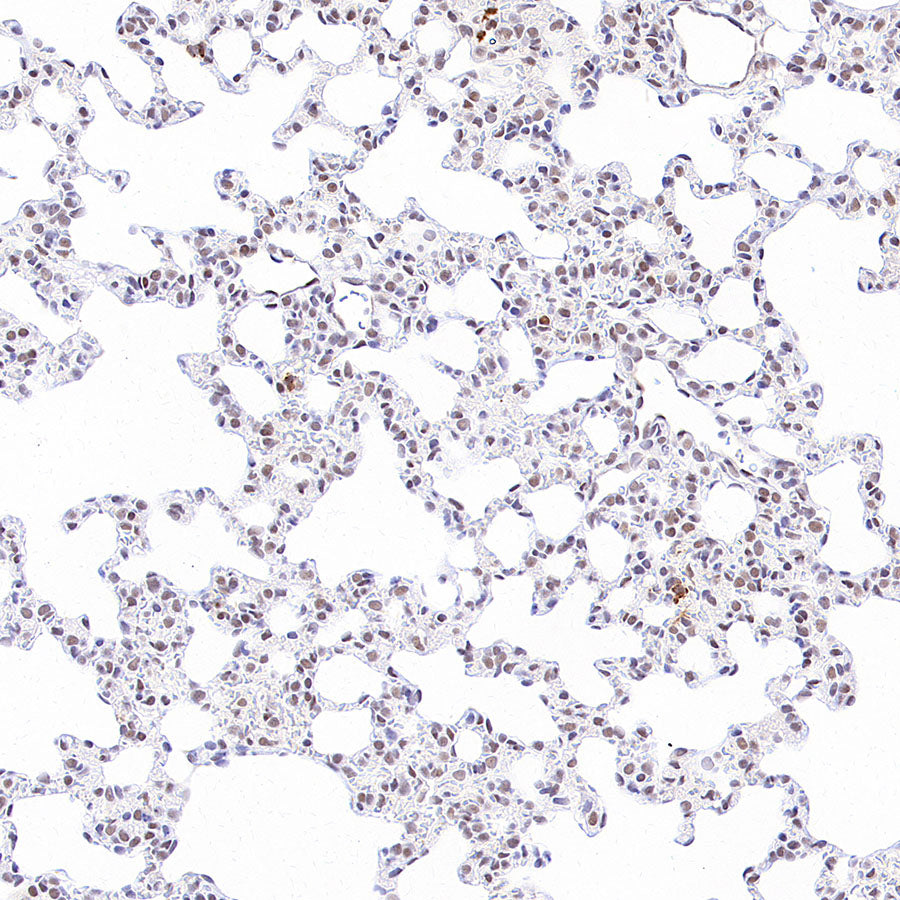
IHC shows positive staining in paraffin-embedded mouse lung. Anti- Phospho-STAT1(Ser727) antibody was used at 1/500 dilution, followed by a HRP Polymer for Rabbit IgG (ready to use). Counterstained with hematoxylin. Heat mediated antigen retrieval with Tris/EDTA buffer pH9.0 was performed before commencing with IHC staining protocol.
IHC shows positive staining in paraffin-embedded rat colon. Anti- Phospho-STAT1(Ser727) antibody was used at 1/500 dilution, followed by a HRP Polymer for Rabbit IgG (ready to use). Counterstained with hematoxylin. Heat mediated antigen retrieval with Tris/EDTA buffer pH9.0 was performed before commencing with IHC staining protocol.
IHC shows positive staining in paraffin-embedded rat lung. Anti- Phospho-STAT1(Ser727) antibody was used at 1/500 dilution, followed by a HRP Polymer for Rabbit IgG (ready to use). Counterstained with hematoxylin. Heat mediated antigen retrieval with Tris/EDTA buffer pH9.0 was performed before commencing with IHC staining protocol.