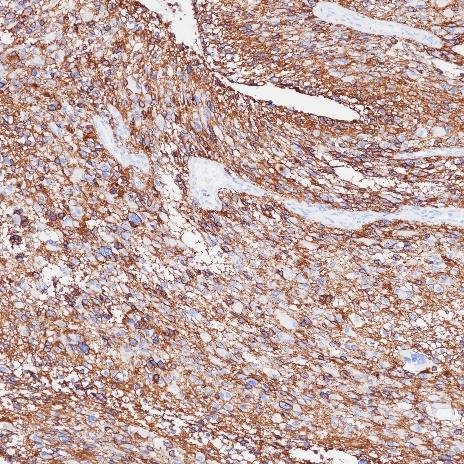
Immunohistochemistry (Formalin/PFA-fixed paraffin-embedded sections analysis of human glioma tissue labelling CD56 with BP6156. Heat mediated antigen retrieval was performed using Tris/EDTA buffer pH 9.0
CD56 Recombinant Rabbit Monoclonal Antibody
CD56 Recombinant Rabbit Monoclonal Antibody
Price:
Regular price
$100 USD
Regular price
Sale price
$100 USD
Unit price
per
For shipping services or bulk orders, you may request a quotation.
Secure checkout with

View full details
Product Details
Product Details
Product Specification
| Host | Rabbit |
| Immunogen | Synthetic Peptide |
| Location | Membrane |
| Accession | P13591 |
| Antibody Type | Recombinant mAb |
| Application | IHC-P |
| Reactivity | Hu |
| Purification | Protein A |
| Conjugation | Unconjugated |
| Physical Appearance | Liquid |
| Storage Buffer | PBS 59%, Sodium azide 0.01%, Glycerol 40%, BSA 0.05%. |
| Stability & Storage | -25°C to -18°C |
Dilution
| application | dilution | species |
| IHC-P | 1:100-1:200 |
Background
CD56, also known as neural cell adhesion molecule (NCAM), is a calcium-independent homophilic binding protein that belongs toa group of cell adhesion molecules including cadherins, selectins, and integrins. CD56 is involved in cell–cell adhesion of neuralcells during embryogenesis and is expressed on most neuroectodermally derived tissues. In normal tissue, anti-CD56 labelsneurons, glia, schwann cells, NK (natural killer) cells, and a subset of T-cells. CD56 expression can be seen in most NK cellneoplasms, certain subtypes of T-cell lymphoma and in some plasma cell neoplasms.
Picture
Picture
Immunohistochemistry