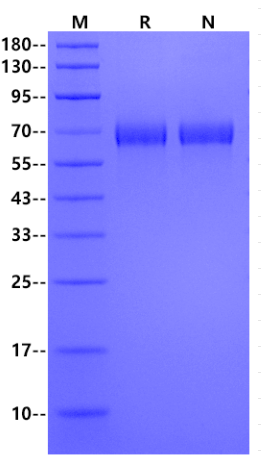
2μg (R: reducing condition, N:non-reducing condition).
Cathepsin F His Tag Protein, Human
Cathepsin F His Tag Protein, Human
Price:
Regular price
$250 USD
Regular price
Sale price
$250 USD
Unit price
per
For shipping services or bulk orders, you may request a quotation.
Secure checkout with

View full details
Product Details
Product Details
Product Specification
| Species | Human |
| Synonyms | Cathepsin F,CTSF |
| Accession | Q9UBX1 |
| Amino Acid Sequence | Ala20-Asp484 with His Tag at the C-Terminus |
| Expression System | HEK293 |
| Molecular Weight | 60-75kDa (Reducing) |
| Purity | >95% by SDS-PAGE |
| Conjugation | Unconjugated |
| Tag | His Tag |
| Physical Appearance | Lyophilized powder |
| Storage Buffer | PBS, PH7.4, 5% trehalose |
| Reconstitution | Reconstitute at 0.1-1 mg/ml according to the size in ultrapure water after rapid centrifugation. |
| Stability & Storage | · 12 months from date of receipt, lyophilized powder stored at -20 to -80℃. |
| Reference | 1.Wang X, Zhu Z. Unraveling the causal relationship and underlying mechanisms between cathepsins on liver cancer: findings from mendelian randomization and bioinformatics analysis. Discov Oncol. 2025 Mar 7;16(1):277. |
Background
CTSF (Cathepsin F) is a cysteine protease primarily localized in lysosomes. Its protein structure contains a typical catalytic domain of cysteine proteases, which specifically cleaves peptide bonds through its active site. Within the cell, it is responsible for degrading abnormal or damaged proteins and participates in antigen processing and presentation, thereby regulating immune responses. Clinically, aberrant expression or dysfunction of CTSF is closely associated with various diseases: its overexpression may promote tumor invasion and metastasis, while in autoimmune diseases, it may lead to immune imbalance due to disrupted antigen processing. Consequently, CTSF has emerged as a potential disease biomarker and therapeutic target.
Protocol
Experimental Methods
Principle: To assess the ability of Cathepsin F His Tag Protein, Human to cleave the fluorescent peptide substrate Z-FR-AMC.
Materials:
Protein activation buffer: 50 mM sodium acetate pH 4.5, 5 mM DTT
Assay buffer: 100 mM Sodium acetate (pH 5.5), 2 mM EDTA, 8 mM DTT
Cathepsin F His Tag Protein, Human (UA011221)
Substrate: Z-FR-AMC (C350145)
96-well ELISA Removable Plate, Black, High binding (GENEVER, Catalog # GMO2-96H)
Plate reader (PerkinElmer, excitation wavelength 360 nm, emission wavelength 460 nm)
Experimental Procedure
Activate Cathepsin F His Tag Protein, Human in protein activation buffer at room temperature for 90 minutes before the reaction.
Dilute the activated Cathepsin F His Tag Protein, Human in assay buffer to concentrations of 15 µg/mL, 7.5 µg/mL, 3.75 µg/mL, 1.875 µg/mL, 0.93575 µg/mL, 0.48 µg/mL, and 0 µg/mL.
Dilute Z-FR-AMC to 40 µM in assay buffer.
Add 50 µL of the diluted Cathepsin F His Tag Protein, Human to each well of a black plate, followed by 50 µL of 40 µM substrate, and incubate at 30°C for 40-120 min.
Measure fluorescence at excitation and emission wavelengths of 360 nm and 460 nm, respectively.
Calculate specific activity:
| Specific Activity (pmol/min/µg) = | Adjusted Fluorescence* (RFU) x Conversion Factor** (pmol/RFU) |
| Incubation time (min) x amount of enzyme (µg) |
*Blank-corrected substrate fluorescence
**Derived using the calibration standard 7-amino-4-Methyl Coumarin
Picture
Picture
SDS-PAGE