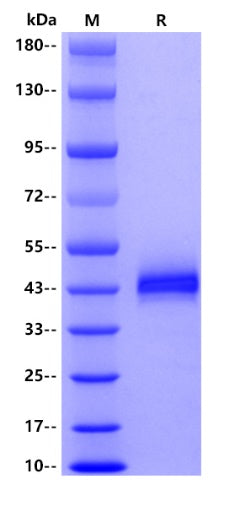
2μg(R: reducing conditions)
Cathepsin B His tag Protein, Human
Cathepsin B His tag Protein, Human
Price:
Regular price
$570 USD
Regular price
Sale price
$570 USD
Unit price
per
For shipping services or bulk orders, you may request a quotation.
Secure checkout with

View full details
Product Details
Product Details
Product Specification
| Species | Human |
| Synonyms | APP secretase (APPS), Cathepsin B1, CPSB |
| Accession | P07858 |
| Amino Acid Sequence | Met1-Ile339, with C-10*His |
| Expression System | HEK293 |
| Molecular Weight | Predicted MW: 39.5 kDa Observed MW: 43 kDa |
| Purity | >95% by SDS-PAGE |
| Endotoxin | <1EU/μg |
| Conjugation | Unconjugated |
| Tag | His Tag |
| Physical Appearance | Lyophilized powder |
| Storage Buffer | 0.2M PBS, pH7.4. |
| Reconstitution | Reconstitute no more than 1 mg/mL according to the size in deionized water after rapid centrifugation. |
| Stability & Storage |
|
Background
Cathepsin B belongs to a family of lysosomal cysteine proteases known as the cysteine cathepsins and plays an important role in intracellular proteolysis. In humans, cathepsin B is encoded by the CTSB gene. Cathepsin B is upregulated in certain cancers, in pre-malignant lesions, and in various other pathological conditions. Cathepsin B may enhance the activity of other proteases, including matrix metalloproteinase, urokinase (serine protease urokinase plasminogen activator), and cathepsin D, and thus it has an essential position for the proteolysis of extracellular matrix components, intercellular communication disruption, and reduced protease inhibitor expression. Cells may become carcinogenic when cathepsin B is unregulated. Cathepsin B has been proposed as a potentially effective biomarker for a variety of cancers. Overexpression of cathepsin B is correlated with invasive and metastatic cancers.
Protocol
Assay protocol
Principle: Measured by its ability to cleave the fluorogenic peptide substrate, Z-LR-AMC.
Materials
1.Protein Activation Buffer: 25 mM MES, 5 mM DTT, pH 5.0
2.Assay Buffer: 25 mM MES,0.02% Brij-35, pH 5.0
3.Human Cathepsin B, His tag)
4.Substrate: Z-LR-AMC (ES008)
5.96 ELISA Removable Plate, Black, High binding (GENEVER, Catalog # GMO2-96H)
6.Plate Reader (PerkinElmer, excitation 380 nm and emission 460 nm)
Produce
1.Dilute Cathepsin B to 10 μg/mL in Activation Buffer.
2.Incubate at room temperature for 15 minutes.
3.Dilute Cathepsin B to 0.4, 0.2 and 0.1 μg/mL in Assay Buffer.
4.Dilute substrate to 80 μM in Assay Buffer.
5.Load 50 μL of the 0.4, 0.2 and 0.1 μg/mL Cathepsin B in a black well plate, and start the reaction by adding 50 μL of 80 μM Substrate. Include a Substrate Blank containing 50 μL Assay Buffer and 50 μL of 80 μM Substrate.
6.Read at excitation and emission wavelengths of 380 nm and 460 nm (top read), respectively, in kinetic mode for 5 minutes. Calculate specific activity:
Specific Activity (pmol/min/µg) = |
Adjusted Vmax* (RFU/min) x Conversion Factor** (pmol/RFU) |
amount of enzyme (µg) |
*Adjusted for Substrate Blank
**Derived using calibration standard 7-amino-4-Methyl Coumarin
Picture
Picture
SDS-PAGE