


GIPR His Tag Protein, Human
GIPR His Tag Protein, Human

Product Details
Product Details
Product Specification
| Species | Human |
| Accession | P48546-1 |
| Amino Acid Sequence | Arg22-Gln138, with C-terminal 8*His |
| Expression System | HEK293 |
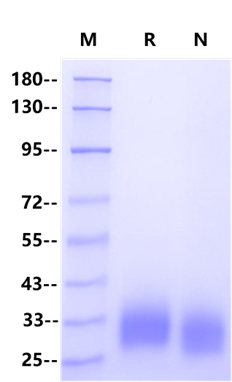
| Molecular Weight | 25-34 kDa(Reducing) |
| Purity | >95% by SDS-PAGE |
| Endotoxin | <0.1EU/μg |
| Conjugation | Unconjugated |
| Tag | His Tag |
| Physical Appearance | Lyophilized Powder |
| Storage Buffer | PBS, pH7.4 |
| Reconstitution | Reconstitute at 0.1-1 mg/ml according to the size in ultrapure water after rapid centrifugation. |
| Stability & Storage |
· 12 months from date of receipt, lyophilized powder stored at -20 to -80℃. · 3 months, -20 to -80℃ under sterile conditions after reconstitution. · 1 week, 2 to 8℃ under sterile conditions after reconstitution. · Please avoid repeated freeze-thaw cycles. |
Background
Glucose-dependent insulinotropic polypeptide receptor (GIPR) are G protein-coupled receptors belonging to the secretin receptor super-family, also known as class B1. GIPR comprises an N-terminal extracellular domain (ECD), a central domain consisting of seven transmembrane α-helices, and a C-terminal, cytoplasmic domain that mediates intracellular signal transduction by physical association with the G protein. GIPR increases insulin secretion in hyperglycemia and stimulates glucagon release in hypoglycemia. It also plays an important role in adipogenesis, islet β cell proliferation and insulin release, and is associated with type 2 diabetes, obesity and neurodegenerative diseases.
Picture
Picture
SDS-PAGE
ELISA
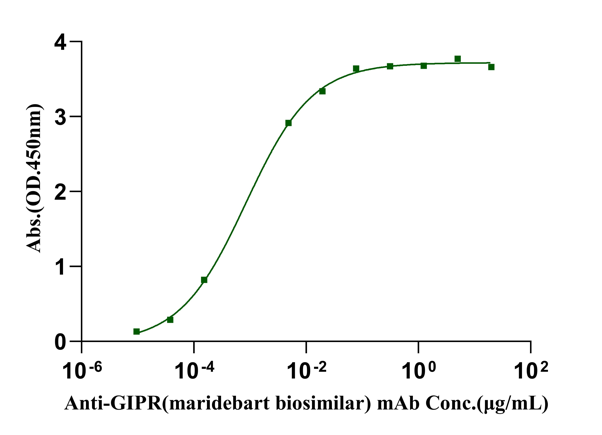
Immobilized GIPR His Tag Protein, Human (Cat. No. UA010066) at 2.0μg/mL (100μL/well) can bind Biotinylated Anti-GIPR(maridebart biosimilar) mAb
with EC50 of 0.6-1.1 ng/ mL.

