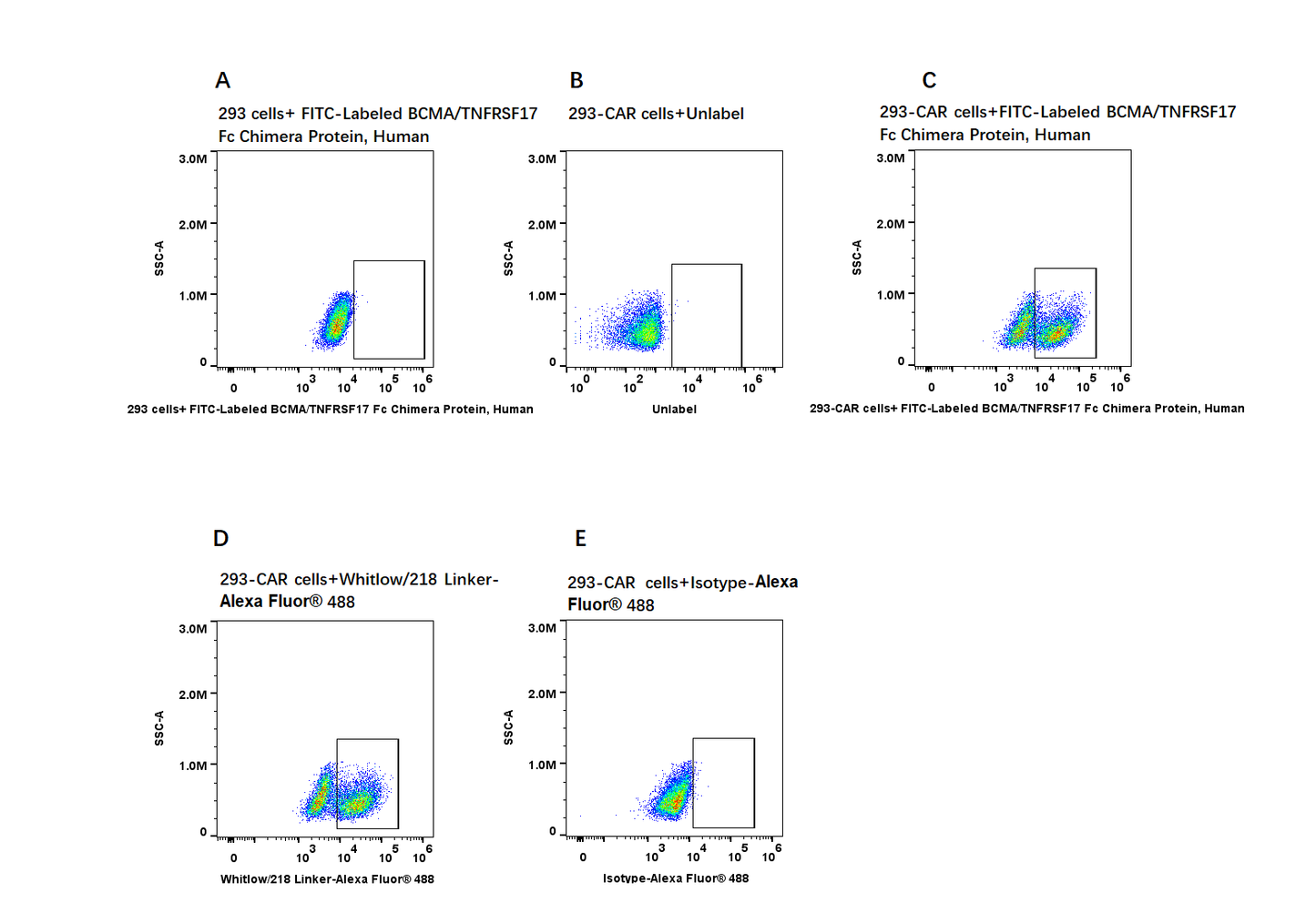


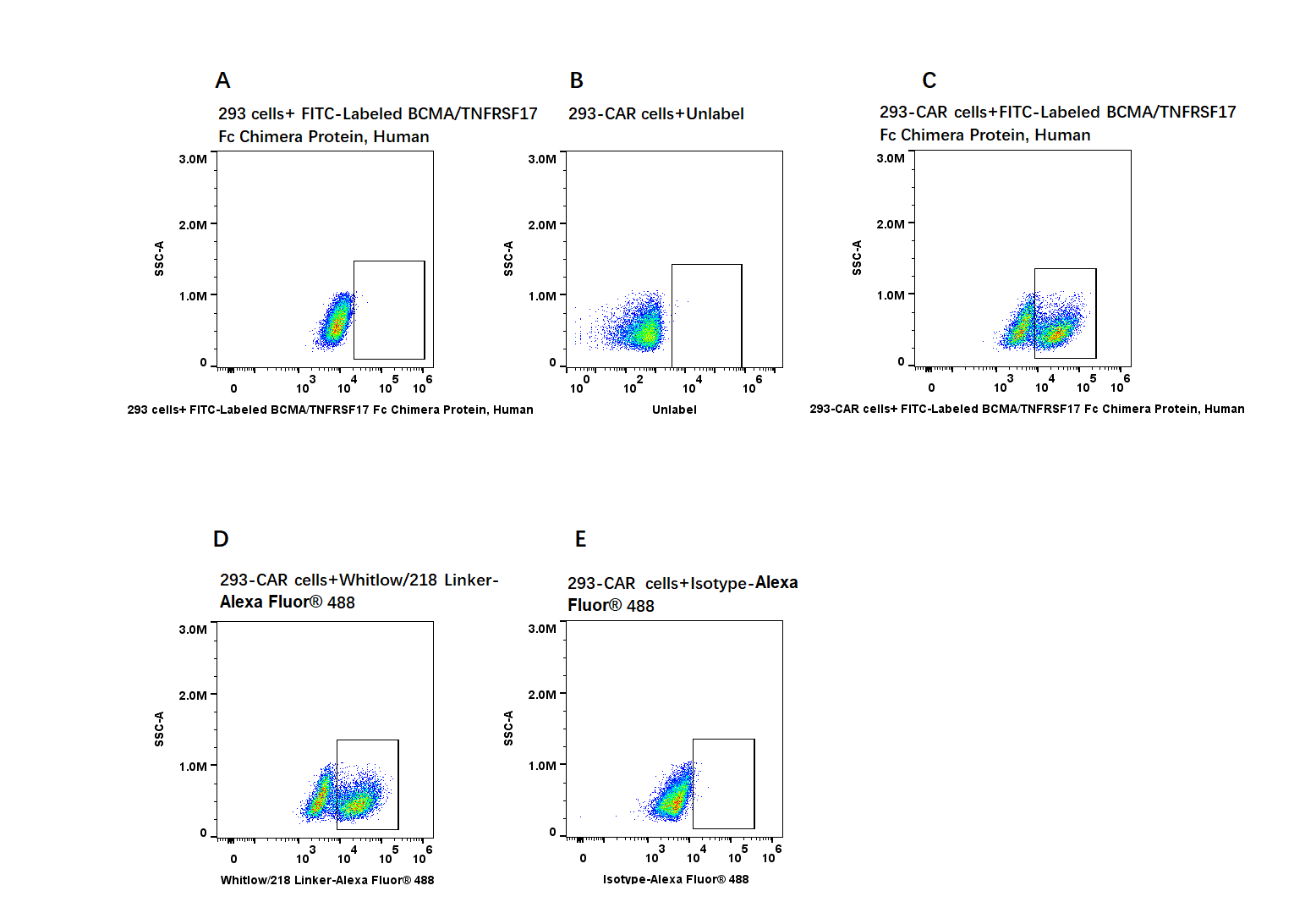
2e5 of transient transfected anti- BCMA ScFv CAR-293 cells were stained with 0.1ug FITC-Labeled BCMA/TNFRSF17 Fc Chimera Protein, Human, (Cat. No. UA010365) and unlable respectively (Fig. C and B), and non-transfected 293 cells were used as a control (Fig. A). FITC signal was used to evaluate the binding activity.2e5 of transient transfected anti- BCMA ScFv CAR-293 cells were stained with isotype and Whitlow/218 Linker-Alexa Fluor® 488 (Fig. D and E). Alexa Fluor® 488 signal was used to evaluate the binding activity.
FITC-Labeled BCMA/TNFRSF17 Fc Chimera Protein, Human
FITC-Labeled BCMA/TNFRSF17 Fc Chimera Protein, Human
Price:
Regular price
$512 USD
Regular price
Sale price
$512 USD
Unit price
per
For shipping services or bulk orders, you may request a quotation.
Secure checkout with

View full details
Product Details
Product Details
Product Specification
| Species | Human |
| Synonyms | TNFRSF17,TNFRSF13A,CD269,BCM,BCMA |
| Accession | Q02223 |
| Amino Acid Sequence | Met1-Ala54, with C-terminal human IgG1 Fc |
| Expression System | HEK293 |
| Molecular Weight | 35-40kDa |
| Purity | >95% by SDS-PAGE |
| Endotoxin | <0.1EU/μg |
| Conjugation | FITC |
| Physical Appearance | Lyophilized powder |
| Storage Buffer | PBS, pH7.4 |
| Reconstitution | Reconstitute at 0.1-1 mg/ml according to the size in ultrapure water after rapid centrifugation. |
| Stability & Storage |
· 12 months from date of receipt stored at --20 to -80℃. · 1 week, 2 to 8℃ under sterile conditions · Recommend to aliquot the protein into smaller quantities for optimal storage. · Please avoid repeated freeze-thaw cycles. |
| Reference |
1、Novak A J. et al. (2004) Expression of BCMA, TACI, and BAFF-R in multiple myeloma: a mechanism for growth and survival. Blood. 103(2): 689-694. 2、O'Connor B P. et al. (2004) BCMA is essential for the survival of long-lived bone marrow plasma cells. J Exp Med. 199(1): 91-98. 3、Moser K. et al. (2006) Stromal niches, plasma cell differentiation and survival. Curr Opin Immunol. 18(3): 265-270. |
Background
BCMA (The B-cell maturation antigen), also designated as TNFRSF17, belongs to the tumor necrosis factor receptor superfamily, which is a family of cytokine receptors. BCMA is encoded by a 2.92-kb TNFRSF17 gene located on the short arm of chromosome 16 (16p13.13) and composed of 3 exons separated by 2 introns. There are four natural splice variants of human BCMA that present with different receptor binding affinities, membrane-anchoring ability, and intracellular domain signaling. BCMA main ligands are the cytokines B-cell activating factor and a proliferation-inducing ligand. The interaction between BCMA and its ligands activates the NF-κB signaling pathway that plays an important role in B-cell proliferation and maturation and is essential for the survival of long-lived bone marrow plasma cells. BCMA is expressed preferentially on mature B cells and has minimal expression on hematopoietic stem cells or other cell types. The BCMA has emerged as a central target in multiple myeloma (MM). In preclinical studies, overexpression of BCMA and the interaction with is ligand, a proliferation-inducing ligand (APRIL), was found to promote MM progression in vivo and augment MM cell growth and survival through induction of multiple signaling cascades, including protein kinase B (AKT), MAPK, and nuclear factor (NF)-κB. Additionally, BCMA has been shown to be solubilized at high levels in serum of patients with MM (sBCMA). This form of sBCMA binds to B-cell activating factor (BAFF). The role of BAFF is to stimulate normal B-cell and plasma cell development; however, this functioning is prevented when it is bound by BCMA in the serum, thereby leading to decreased polyclonal immunoglobulin levels in patients with MM.
Picture
Picture
FC
Bioactivity
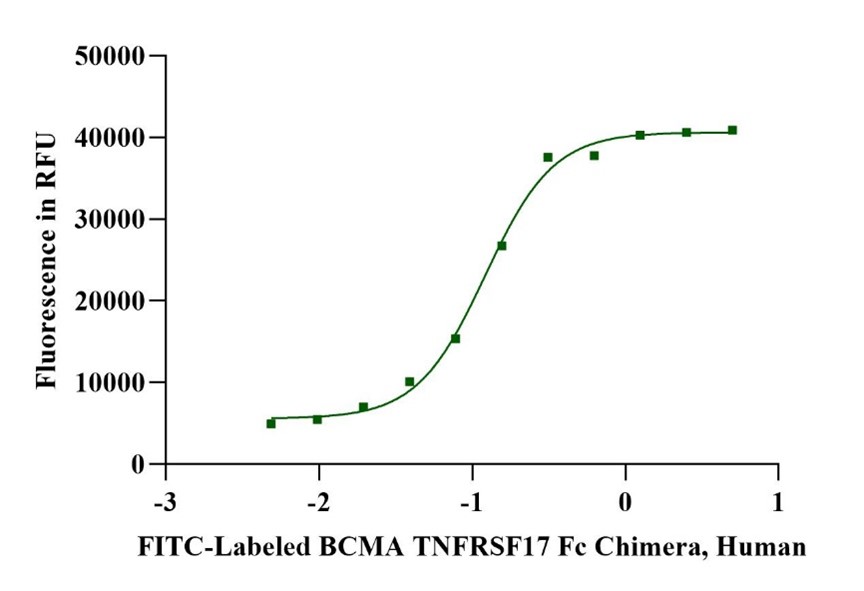
Immobilized Anti-Human BCMA(Belantamab) Monoclonal Antibody at 2 μg/mL (100 μL/well) can bind FITC-Labeled BCMA TNFRSF17 Fc Chimera, Human with EC50 of 0.12 μg/mL.
SDS-PAGE
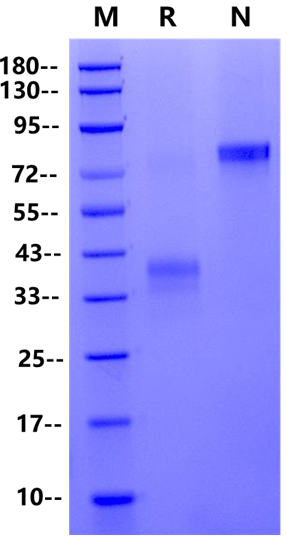
1μg(R: reducing conditions, N: non-reducing conditions).