ACPP/ACP3 His Tag Protein, Human
ACPP/ACP3 His Tag Protein, Human

Product Details
Product Details
Product Specification
| Species | Human |
| Synonyms | ACP3,PAP,5'-NT,ACP-3,Prostatic Acid Phosphatase |
| Accession | P15309 |
| Amino Acid Sequence | Lys33-Asp386, with C-terminal His Tag |
| Expression System | HEK293 |
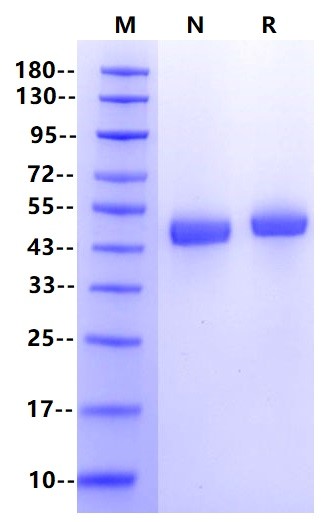
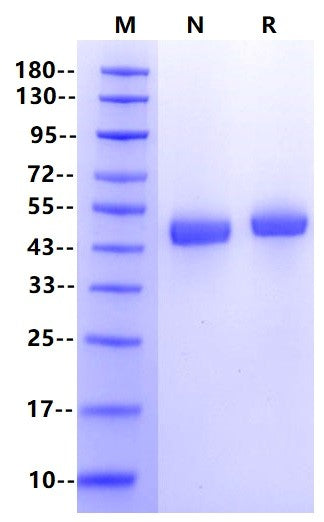
| Molecular Weight | 45-50kDa (Reducing) |
| Purity | >95% by SDS-PAGE |
| Endotoxin | <0.1EU/μg |
| Conjugation | Unconjugated |
| Tag | His Tag |
| Physical Appearance | Lyophilized powder |
| Storage Buffer | PBS, 5% Trehalose, pH7.4 |
| Reconstitution | Reconstitute at 0.1-1 mg/ml according to the size in ultrapure water after rapid centrifugation. |
| Stability & Storage |
· 12 months from date of receipt, lyophilized powder stored at -20 to -80℃. · 3 months, -20 to -80℃ under sterile conditions after reconstitution. · 1 week, 2 to 8℃ under sterile conditions after reconstitution. · Please avoid repeated freeze-thaw cycles. |
Background
Prostatic acid phosphatase (PAP, or ACPP), also known as prostatic specific acid phosphatase (PSAP), is an enzyme produced by the prostate. As a non-specific phosphomonoesterase, Prostatic acid phosphatase is synthesized and secreted into seminal plasma under androgenic control. The enzyme is a dimer of molecular weight around 100 kDa. Prostatic Acid Phosphatase (ACPP) catalyzes the hydrolysis of a variety of phosphate monoesters, including phosphorylated proteins. The activity optimum of ACPP is in the pH range of 4-6, and the activity is inhibited by L(+)-tartrate. ACPP expression levels are highest in the prostate, with much lower expression in most other tissues. ACPP is a type I integral membrane protein of the plasma membrane and lysosomes, and a secreted form also exists. The concentration of ACPP is elevated in the circulation of prostate cancer patients, making the enzyme a marker for the progression of prostate cancer. Cellular ACPP has been shown to be a protein tyrosine phosphatase. Protein substrates include the epidermal growth factor receptor and HER-2. Cellular ACPP is considered to function as a tumor suppressor.
Protocol
Assay protocol
Principle: Measured by its ability to cleave a substrate, p-Nitrophenyl phosphate (pNPP).
Materials
Assay Buffer: 50 mM NaOAc, pH 4.5
ACPP His Tag Protein, Human
Substrate: p-Nitrophenyl phosphate (Sigma-Aldrich, Catalog # 241326)
NaOH, 0.2 M in deionized water
Calibration standard :4-Nitrophenol (Sigma-Aldrich, Catalog #N2765)
96 Well Clear Plate (BIOFIL, Catalog#011096)
Plate Reader (PerkinElmer)
Produce
Dilute Prostatic Acid Phosphatase Protein to 0.4 μg/mL in Assay Buffer.
Dilute Substrate to 2 mM in Assay Buffer.
Load in a plate 50 μL of dilute Prostatic Acid Phosphatase Protein (From the step 1) and start the reaction by adding 50 μL of 2 mM Substrate to wells. Include a Substrate with Assay Buffer as Blank.
Incubate reaction at room temperature for 5 minutes.
Add 100 μL of 0.2 M NaOH to stop the reaction and develop the color.
Read (top read) absorbance in endpoint mode at 410 nm.
Calculate specific activity.
Specific Activity (pmol/min/µg) = |
Adjusted Vmax (OD)x Conversion Factor (pmol/OD) |
Incubation time(min) x amount of enzyme (μg) |
-
Standard Curve
-
Dilute Calibration standard to 500 μM in Assay Buffer and prepare serial dilutions.
-
Add 100 μL of each serially diluted standard and blank (Assay buffer) into appropriate wells of a 96-well, the standard curve has a range of 50000,25000 12500, 6250,3125,1563/781 pmol per well.
Add 100 μL of 0.2 M NaOH to each serially diluted standard blank (Assay buffer).
Read at a wavelength of 410 nm, respectively in endpoint mode.
Linear Regression of 4-Nitrophenol (pmol)(y) –RFU-Blank(x).
-
-
Picture
Picture
SDS-PAGE