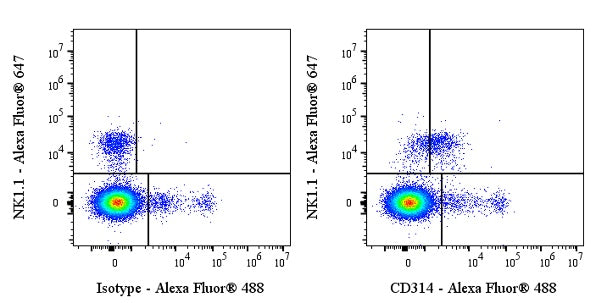
Flow cytometric analysis of C57BL/6 mouse splenocytes labeled with Mouse CD314 antibody at 1/500 dilution (1 μg) / (right panel) compared with a Rat IgG1, κ Isotype Control / (left panel). Goat Anti-Rat IgG Alexa Fluor® 488 was used as the secondary antibody. Then cells were stained with NK1.1 - Alexa Fluor® 647 antibody separately. Flow cytometry and data analysis were performed using Agilent NovoCyte Quanteon and FlowJo™ software.
Invivo anti-Mouse CD314 (NKG2D) Recombinant mAb
Invivo anti-Mouse CD314 (NKG2D) Recombinant mAb
Price:
Regular price
$120 USD
Regular price
Sale price
$120 USD
Unit price
per
For shipping services or bulk orders, you may request a quotation.
Secure checkout with

View full details
Product Details
Product Details
Product Specification
| Host | Rat |
| Antigen | CD314 (NKG2D) |
| Synonyms | NKG2-D type II integral membrane protein; Killer cell lectin-like receptor subfamily K member 1; NK cell receptor D; NKG2-D-activating NK receptor; Nkg2d; Klrk1 |
| Location | Cell membrane |
| Accession | O54709 |
| Clone Number | CX5 |
| Antibody Type | Rat mAb |
| Isotype | Rat IgG1,k |
| Isotype Control | Invivo rat IgG1 Isotype control, anti-trinitrophenol |
| Application | FCM, in vivo CD314 blockade, in vitro CD314 blockade |
| Reactivity | Ms |
| Positive Sample | C57BL/6 mouse splenocytes |
| Purification | Protein G |
| Concentration | 5 mg/ml |
| Purity | >95%(Determined by SDS-PAGE) |
| Endotoxin | <1EU/mg |
| Conjugation | Unconjugated |
| Physical Appearance | Liquid |
| Storage Buffer | PBS pH7.4, containing no preservative |
| Stability & Storage | 2 to 8 °C for 2 weeks under sterile conditions; |
Dilution
| application | dilution | species |
| FCM | 1:500 | Ms |
Background
NKG2D is a type II transmembrane C-type lectin-like receptor expressed as a disulfide-linked homodimer on virtually all human and mouse NK cells, γδ T cells, and CD8+ αβ T cells; upon engagement by stress-inducible MHC class I–related ligands (MICA/B, ULBPs in humans; Rae-1, H60, Mult1 in mice) it couples to the DAP10 (and in mouse also DAP12) adaptor to deliver phosphotyrosine signals that powerfully lower activation thresholds, costimulate cytotoxicity, and drive proliferation and cytokine release, thereby forming a central surveillance axis that eliminates transformed, infected, or otherwise stressed cells but also contributes to immune-mediated pathologies when ligand expression becomes chronic.
Picture
Picture
FC